

Advertisers know you better than you know yourself
- Published: 12/02/2026
- 7 minutes read

Advertisers know you better than you know yourself
- Published: 12/02/2026
- 7 minutes read
Here’s a thought – how well do you think your devices know you? Let’s see. Most handheld devices track your location. They exchange loads of data, most of which you are totally unaware of. Apps themselves store your age, name, contact list, phone number, email, and more. If you’re on Wi-Fi, they may check your Wi-Fi ID to determine where you’re located, too.
All of these pieces of data allow advertisers to build profiles of vast numbers of people. The leading ones with the most data on you are Google and Meta. What do these companies collect? And as you’re using both Google’s and Meta’s services for free, who is paying them?
“If you’re not paying for the product, you’re the product.”
Tristan Harris
Google - predicting intent
Google is a behemoth when it comes to collecting and processing data. Its portfolio holds so many apps you might not even know Google is behind them.
We have Search – the bread and butter that put Google at the top of the internet. Then we have YouTube, Maps, Gmail, Android OS, the Chrome browser, and many others, allowing Google to collect vast amounts of data from its own apps and third-party sources. Since users are often logged into these apps and services, Google can easily collect information across all of them.
But to take this situation one step further, Google not only collects data, but it also processes it. That way, apps can “infer” information about their users, which is then used to push ads based on your needs, interests, in-market preferences, and a lot more.
Here’s a non-conclusive list of inferred information based on your search history, activity on apps, and the information you browse.
- Demographics (age, gender, parental status, household income, education level, home ownership status, relationship status)
- Interests (YouTube watch history, search queries, websites visited, app usage)
- In-Market intent (short-term signals you’re likely to purchase something)
- Purchase power and spending behavior (Price sensitivity, online shopping behavior)
- Location patterns (Work and home locations, commute patterns, frequently visited places and their types)
- Life events (moved, married, graduated, started a business, expecting a child)
- Device behavior, especially for Android-powered devices (multi-device linking, active hours of day, attention and engagement patterns, ad clicks)
- Behavioral signals (health anxiety, impulsivity, tech adoption speed, political leaning)
- Similarity modelling (lookalike clusters, website audience profiling)
- Offline behavior connected to online services (In-store purchase behavior, data exchange, loyalty programs)
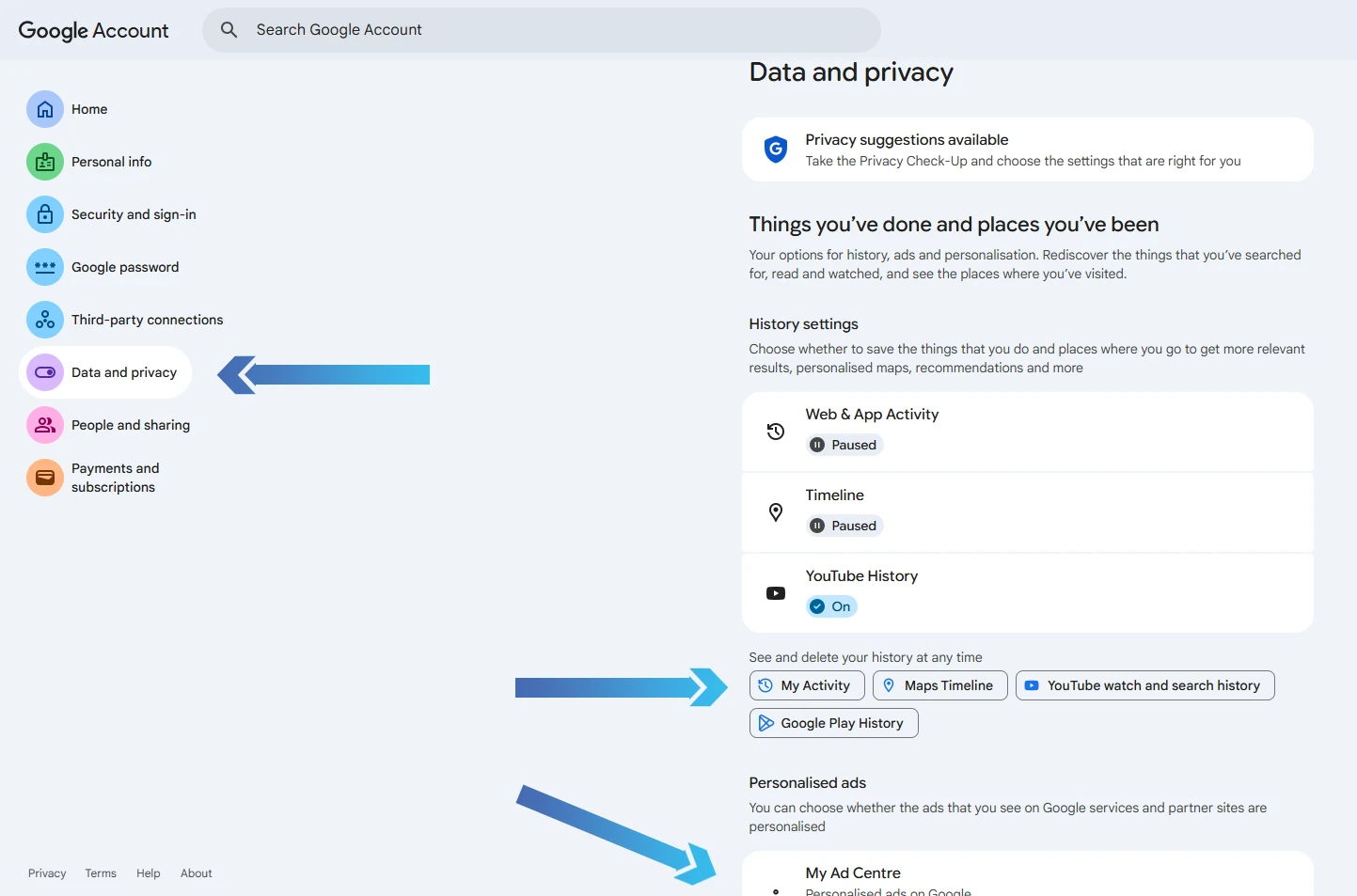
To see what Google knows about you, go to your account, switch to “Data and privacy”, and select My Activity to see your history or My Ad Center to see inferred information.
Or, if you’re logged in – copy or open this link: https://myadcenter.google.com/controls
Meta - predicting behavior
The close second in collecting vast amounts of data used in advertising is Meta. Similar to Google, Meta has several apps that actively collect data on its users: Facebook, Instagram, Messenger, and WhatsApp.
While Google infers data based on intent, Meta focuses more on identity and relationships. Who you are is more relevant to Meta; what you want is relevant to Google.
Here is a non-conclusive list of what data Meta wants to know about you.
- Core demographics (age, gender, relationship status, education level, industry, etc.) are inferred from engagement patterns, pages followed, content interacted with, and device and location patterns
- Psychographic profiling (risk tolerance, openness to ideas, status sensitivity, alignments) is based on reaction types, comment tones, sharing frequency, and other content interaction and participation.
- Identity affiliation (Political leaning, religious affinity, cultural identity, subculture alignment, activism engagement) is oftentimes based on whether you join groups and which ones you join, whether you follow specific pages, and whether you react to certain narratives.
- Relationships and social dynamics (romantic signals, who you influence and who influences you, behavior shifts) include tagging frequency, direct message patterns, engagement reciprocity, and profile interactions.
- Emotional state signals (mood shifts, stress periods, life transitions, achievements) are based on post tones, when you interact with the app, and reaction patterns.
- Economic signals (spending capacity, luxury orientation, discount sensitivity) are based on ad click patterns, shop behavior, and brand engagements.
- Life events (engagement, pregnancy, new parents, moving homes, relationship status changes) are also included in the overall behavior profiling.
- Visual inferences (based on images and videos you upload) provide information on travel habits, social density, and various other socioeconomic signals.
- Attention and addiction modelling (scroll speed, pause duration, micro-hesitations, video completion rates) show attention vulnerability, dopamine response triggers, content susceptibility, and impulse responsiveness.
- Lookalike modelling – if you buy a product, interact with content, click ads, your behavior is compared to million other statistically similar users, and you become either training or advertising input for other users.
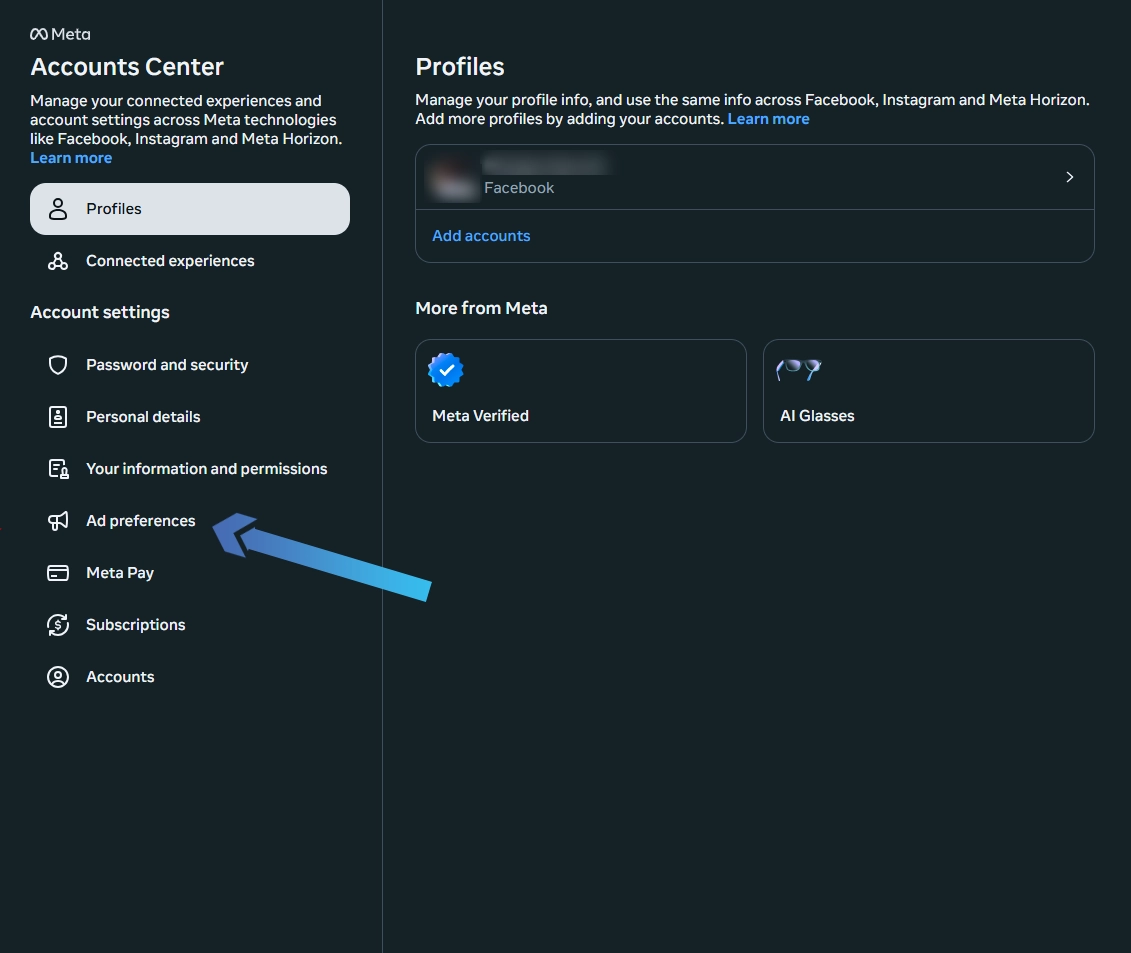
If you want to view your ad preferences on Facebook and manage some of your data, you need to access your account, then go to Ad preferences.
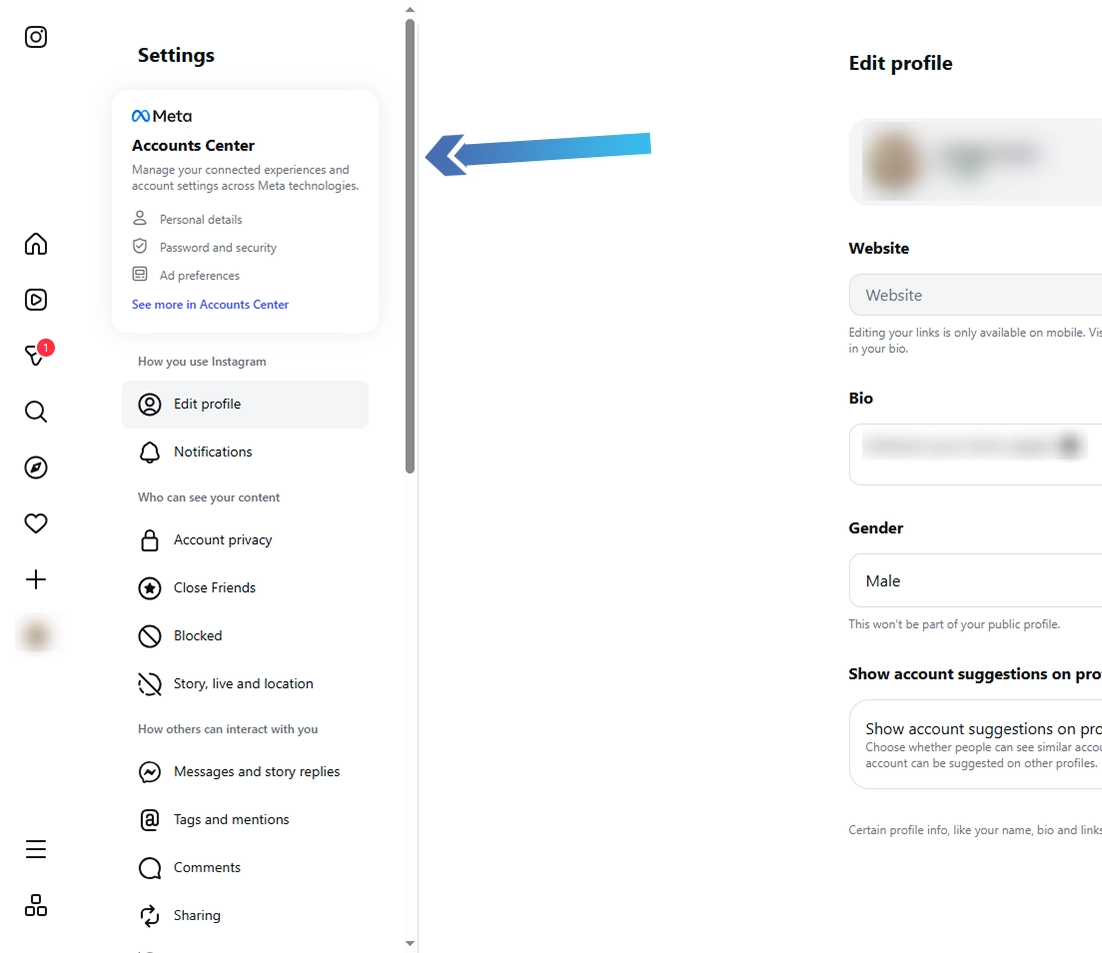
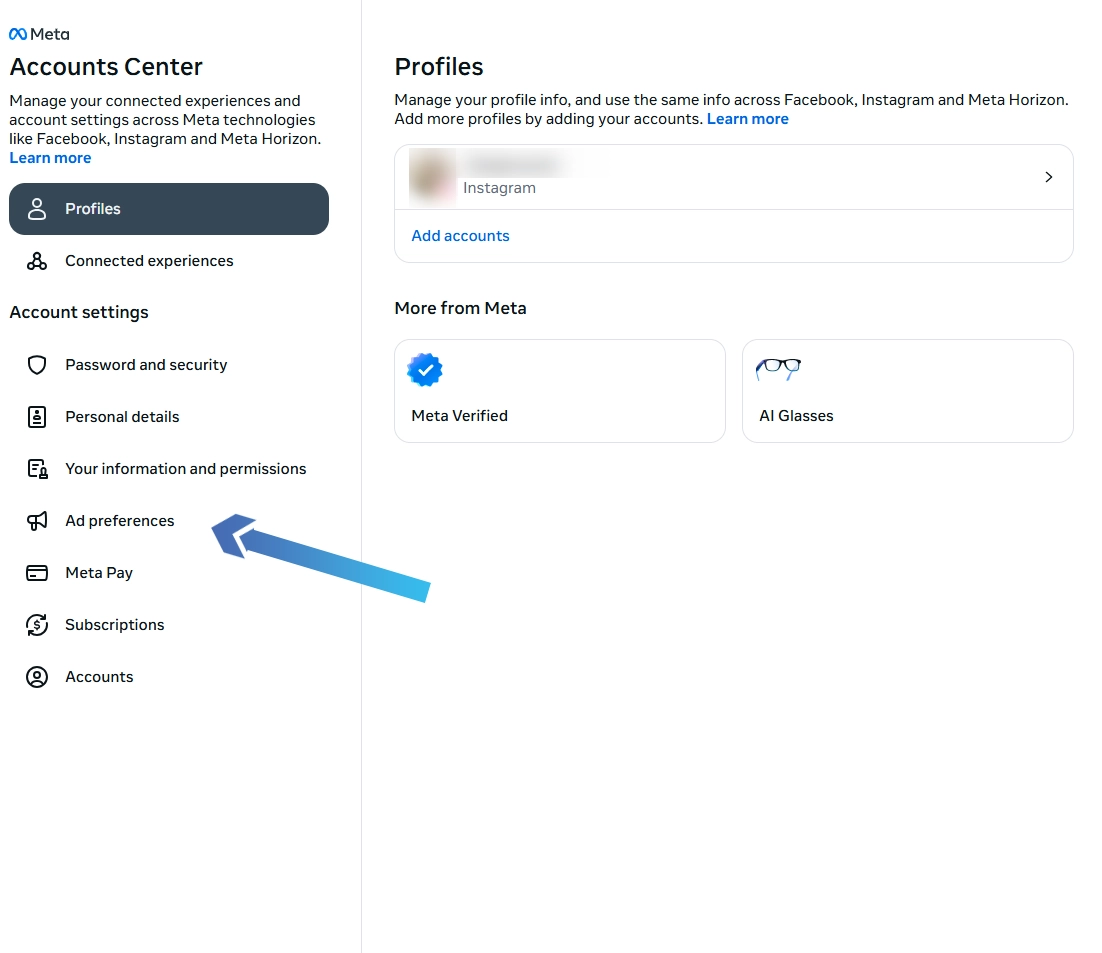
It’s similar for Instagram, you need to access your profile, go to the Accounts center, then ad preferences.
Both Facebook and Instagram even have dedicated features that can potentially track your entire device activity.
How this data is used in advertising
For advertisers, this practice of collecting vast amounts of data has been a gold mine. And although efforts have been made to limit data collection, especially datasets that can easily identify a specific user, it’s still fairly easy to target specific groups of people via ads.
You can create customer personas and use programmatic advertising to target the exact people who match them at the right moment. You can test “hooks”, that is, what you need to say to make people react to your ad. You can use both platforms to test all your assumptions about your customers – what works, what doesn’t, and what you need to do about it.
Both Google and Meta share some overlapping concepts in data collection, but they operate very differently. Advertisers target you with keywords via Google, while they use identity-based targeting and social proof via Meta.
However, having datasets this large for almost every user provides ample room for manipulation. Google allows the results at the top of the search page to go to the highest bidder, which doesn’t necessarily mean the highest bidder provides the best and most reliable information. This used to be true – Google Search did provide somewhat reliable top results before implementing advertising models in its business; there was, of course, SEO malpractice that Google had to weed out, but it was reliable. YouTube works differently from Search and is more in line with how social media works.
Meta, on the other hand, is used to discover novel concepts and explore ideas. Users stumble upon new content in one way or another. But just as Google provides information via algorithms that explore related content, Meta also uses algorithms to suggest related content. If taken to the extreme, it’s relatively easy to build echo chambers on Meta’s platforms and influence people in said echo chambers. And influencing people means influencing decisions. One of the most well-known scandals, which demonstrated how easily people’s decisions can be influenced, involved Cambridge Analytica. It showed that even when data is used commercially, it can also skew public opinion; all you need is a deeper pocket.