

Did the Electric Car Revolution Hit a Speed Bump?
- Published: 10/03/2026
- 9 minutes read

Did the Electric Car Revolution Hit a Speed Bump?
- Published: 10/03/2026
- 9 minutes read
Introduction
For the past decade, the automotive industry has been telling a very confident story. The story went like this: gasoline engines are dying, and electric cars will take over. And by 2035, we’ll all be driving silently into a zero-emission future. Billions were invested. Entire factories were rebuilt. CEOs announced bold timelines. Then something inconvenient happened. The customer didn’t move as fast as the strategy. Today, the global auto industry is discovering a timeless marketing truth that consumers rarely behave the way executives predict. And the numbers are beginning to reveal it.
Reality Vs Strategy
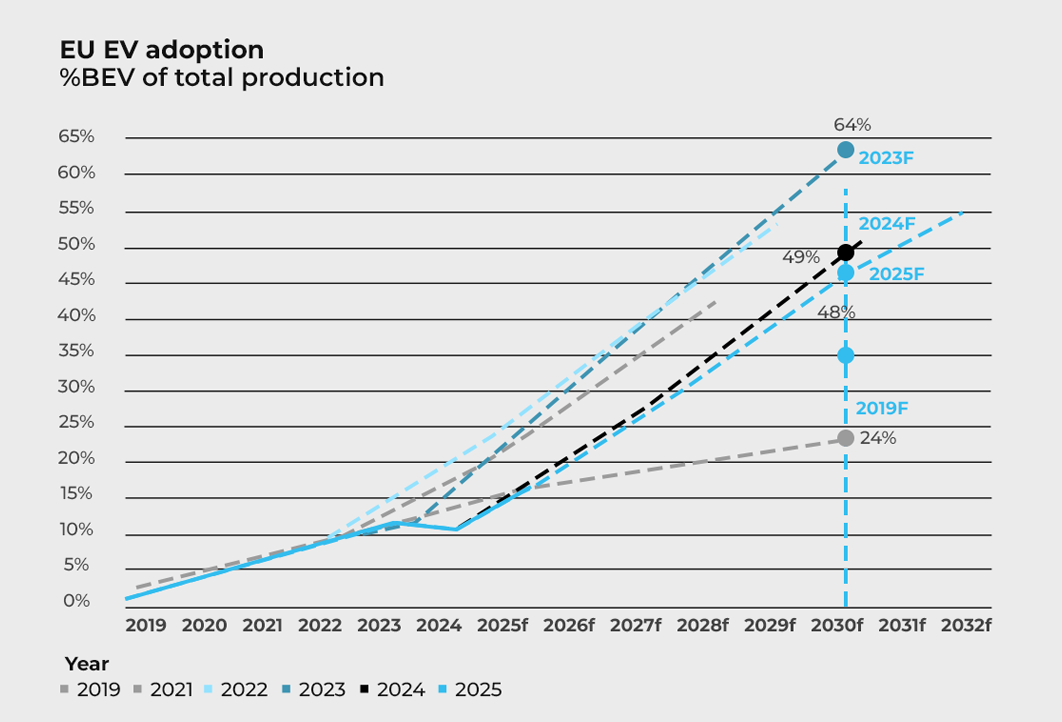
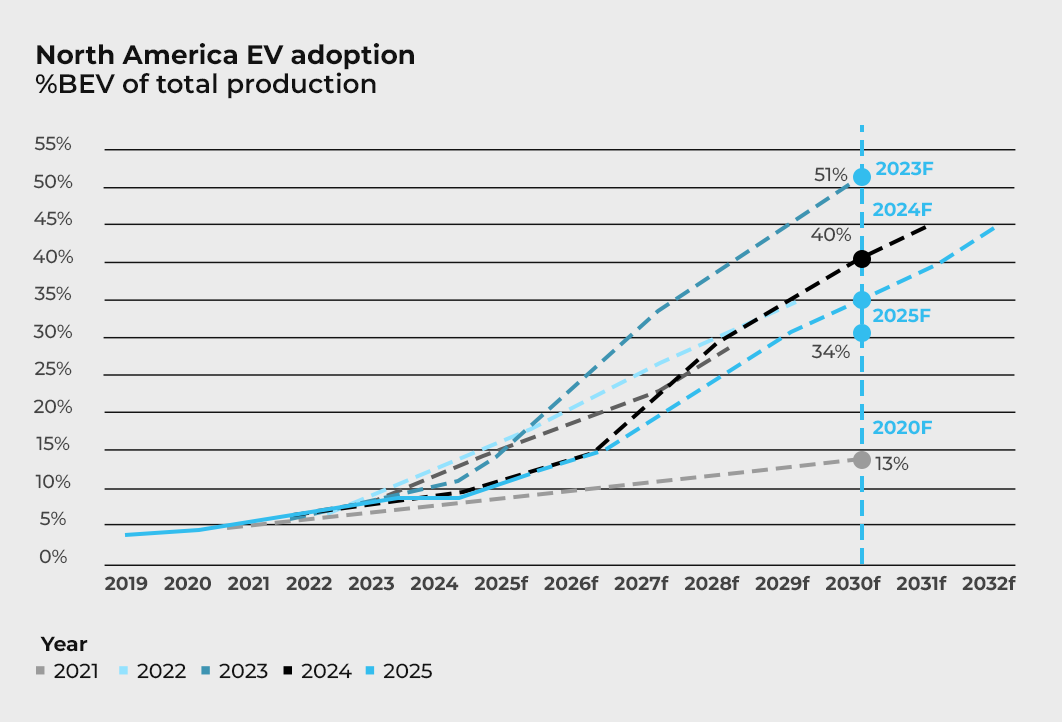
Just a few years ago, the projections indicated that electric vehicles would lead the way in production sooner than anyone thought possible. However, the new projections reveal a vastly different scenario. In North America, the projected share of battery electric vehicles has decreased from 51% to 34% between 2023 and 2025. Even in Europe, the most advanced electric-vehicle market, projections have been reduced from 64% to 48%. This is not a small reduction. This is millions of vehicles that will no longer be electric. One might argue that the industry is not abandoning the electric vehicle. They are learning something much more valuable – that the transition will not be based on corporate timelines. It will be based on consumer timelines.
Aeternus Thoughts
At Aeternus, we follow David Ogilvy’s phrase “the consumer is not a moron; she is your wife”.If you think about that approach in the context of what we’re talking about here, the EV transition makes much more sense. The reality is, consumers aren’t resisting the electrification of their transportation because they don’t know much about it. They are simply trying to get answers to some pretty straightforward questions:
- Can I easily charge the thing?
- Can I afford the thing?
- Can I integrate the thing into my life?
Car brands need to begin thinking of EV adoption as a behavioral change issue, not just a technology rollout. Because technology alone is not enough.
Consumer Fears Holding EVs Back
The automotive industry uses narratives such as sustainability, innovation, and technology in its marketing strategy. But consumers think about something much simpler: how can the car fit into their life?
In fact, studies reveal that there are three key barriers to EV adoption:
- Charging Infrastructure
- Charging Time
- Driving Range
In fact, 20% of EV owners in the USA were unable to charge their cars at public charging stations. These are not trivial issues for consumers. They are deal-breakers.
Survey results confirm this:
- 51% say that there is not enough charging infrastructure
- 49% say that charging time is an issue
- 47% say that the driving range is an issue
But technology is not the answer. Technology will not solve these issues.
Aeternus Thoughts
The EV industry has made a strategic error in judgment. They optimized the product before optimizing the ecosystem. Cars are not like smartphones. Cars require physical infrastructure. Tesla, through its marketing strategy, has been successful partly because it solved this problem early on by creating the Supercharger network. But what about the rest of the automotive brands? They should consider an even more radical option: co-owning the charging networks, as airlines do with airline alliances. Infrastructure experience is likely to become a competitive advantage.
Policy Shock
And if consumers weren’t complicated enough, this change introduced another level of complexity. The US eliminated the tax credits for EVs in 2025:
- $7,500 for new EVs
- $4,000 for used EVs
And suddenly, many EVs cost thousands of dollars more. This won’t be a problem for the early adopters. But the mass market is a different beast, with price sensitivities.
Aeternus Thoughts
The power of subsidies.The illusion of subsidies. A product that sells because of subsidies is different from one that sells because people want it. The EV industry is about to enter a new reality. It won’t be about subsidies. It will be about competition. And competition will be about cheaper batteries, better manufacturing, and better design.
Automotive Brands Are Quietly Changing Course
When reality changes, smart companies change with it. And many automakers are doing just that. General Motors is shifting $4 billion in spending into gasoline-vehicle production. Toyota is doubling down on hybrids. BMW and Stellantis are offering discounts that match the loss of government tax credits. Ford has lost $13 billion on EV spending since 2023, and you don’t lose that kind of money without reevaluating your strategy.
Aeternus Thoughts
The automotive EV industry is learning a lesson that every investor understands – diversification reduces risk. Instead of putting all their eggs in one basket, automakers should be optimizing across multiple powertrains:
- Combustion
- Hybrid
- Plug-in hybrid
- Electric
The future may not belong to those who make the most electric vehicle promises, but to those who diversify.
The Supplier Crisis Nobody Talks About
While car brands can change their strategies, the situation is much more complicated for the suppliers. The original transition plan was quite simple: from internal combustion engines to EVs.However, the situation is quite different from the original plan. Manufacturers have to produce three different kinds of vehicles at the same time:
- Combustion
- Hybrid
- Electric
Each of these requires different parts and has a different production process. This fragmentation eliminates the scale. Instead of producing high volumes of standardized parts, the suppliers are dealing with lower volumes and greater product variation. This is creating significant financial pressure on the suppliers.
Aeternus Thoughts
The situation is creating a complexity trap for suppliers, as economists describe. More technologies mean:
- More SKUs
- More tooling
- More engineering costs
- Less volume per component
The most intelligent supplier will be the one who focuses more on specialization and not diversification. Being the global leader in a narrow component category may be the only safe option for the supplier.
The Strategies Emerging
However, despite the uncertainty, the following are the emerging trends in the industry for forward-thinking automotive brands:
- Accept long coexistence – expect the coexistence of Combustion Engines, Hybrids, and EVs for at least another decade or more.
- Standardize components – more automakers are standardizing vehicle parts, particularly for different vehicle types, in order to reduce costs. Interior parts, display screens, seats, mirrors, and electronic devices can be standardized for different vehicle types.
- Focus EV development strategically – not all vehicle segments require electrification right away. High-volume city cars and high-performance luxury segments are where electrification is most needed and will be most successful.
- Building flexible factories- manufacturing plants that can produce all three vehicle types with the same production line are the future and will be the insurance against future changes in the marketplace.
Aeternus Thoughts
Manufacturing flexibility may be the defining factor in the next generation of the automotive industry. Traditionally, the defining factor for automotive manufacturers has been factory efficiency. However, the future may be defined by factory flexibility. A plant that can produce all three vehicle types on the same line may be worth more than a plant optimized for efficiency in producing only one vehicle type.
The Competitive Threat from China
Perhaps the greatest challenge facing American and European automotive companies is the rising standard of the Chinese EV sector. Chinese manufacturers currently offer cheaper, faster, and often similarly equipped cars. To Western automotive manufacturers, the markets in North America and Europe are currently protected by tariffs. But nothing lasts forever. This is a temporary period of strategic opportunity.
Aeternus Thoughts
Western automotive companies need to view the next five years as a critical period of competitiveness. Rather than waiting for organic growth in demand to occur, Western automotive manufacturers need to focus on radical cost reduction in EVs, software differentiation, battery supply chain independence, and faster product development cycles. If Chinese manufacturers decide to compete aggressively in Western markets once tariffs weaken, price competition could escalate.
The Truth About the Electric Car's Future
The idea that the EV transition would happen rapidly and universally is now giving way to the reality that it is unfolding in different regional waves. As such, the future is not arriving all at once but gradually and differently, depending on the circumstances. Rather than trying to find the right timeline and the right strategy that works universally, automotive companies are now recognizing the need to develop different portfolios depending on the different regions:
- China – dominance by EVs and rapid electrification.
- Europe – a steady transition with mixed results.
- North America – focusing on Hybrids.
- Developing Markets – the dominance of Combustion Engines.
Conclusion
The automotive industry has experienced many significant changes over the years, from the imposition of stringent safety regulations to fuel crises that affected the entire world and quality revolutions that changed how manufacturing was done. All of these have forced automobile companies to re-evaluate their strategies for designing, building, and marketing cars. The transition to electric mobility is arguably the biggest change the automobile industry has faced since the invention of the internal combustion engine. Like every other significant technological advancement, this transition is not expected to happen in a straight line. It is expected to unfold at different speeds across markets and will likely throw up surprises along the way. As a result, the automobile companies expected to succeed are not those that have made the most ambitious claims and announcements, but those that have stayed grounded and connected with their buyer personas. The automobile industry will not be guided by any strategic announcements or declarations, but by the market itself. The market is not known to follow any predictable course.