Enterprise marketing strategy for software products and IT services
- Published: 15/09/2026
- 23 minutes read

Enterprise marketing strategy for software products and IT services
- Published: 15/09/2026
- 23 minutes read
Executive summary
Enterprise technology marketing is, above all, a decision-making problem. Buyers need to understand why the issue matters, why your company is credible, how implementation will work, and whether the commercial case holds together. This guide examines the strategic decisions software product and IT services companies need to get right before scaling demand, from choosing the right customer problem to supporting adoption and delivering profitable work.
What you’re currently experiencing
Your company may have a good product, an experienced team, and satisfied clients. Still, new enterprise buyers often struggle to see why they should choose you, why you matter now, and how what you offer fits into their internal workflow.
This gap affects sales – products become just another tool, companies compare rates, and promising opportunities stall as approvals are delayed.
An effective marketing strategy bridges this gap by aligning your offerings with customer priorities, providing convincing evidence, and supporting decision-making from discovery to expansion.
The approach varies with the business model. Software buyers can evaluate an existing product, even when deployment requires extensive work. Services buyers also need assurance about the people, responsibilities, and delivery arrangements that will produce a future result.
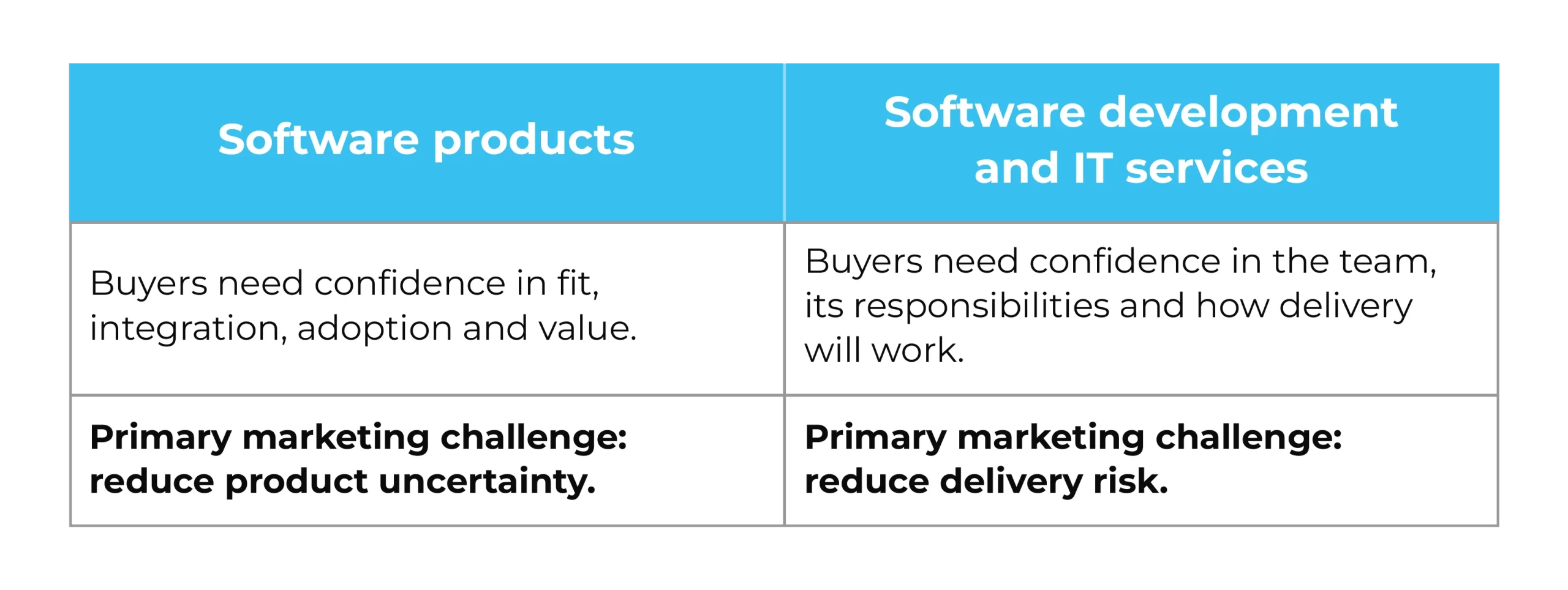
Companies offering both must clarify the boundary between product and service.
At Aeternus, we start by understanding the business, its customers, and growth obstacles. Research guides where to look, while strategic decisions reflect your market, capabilities, and economics. Here is how we approach a marketing strategy for companies in the IT industry.
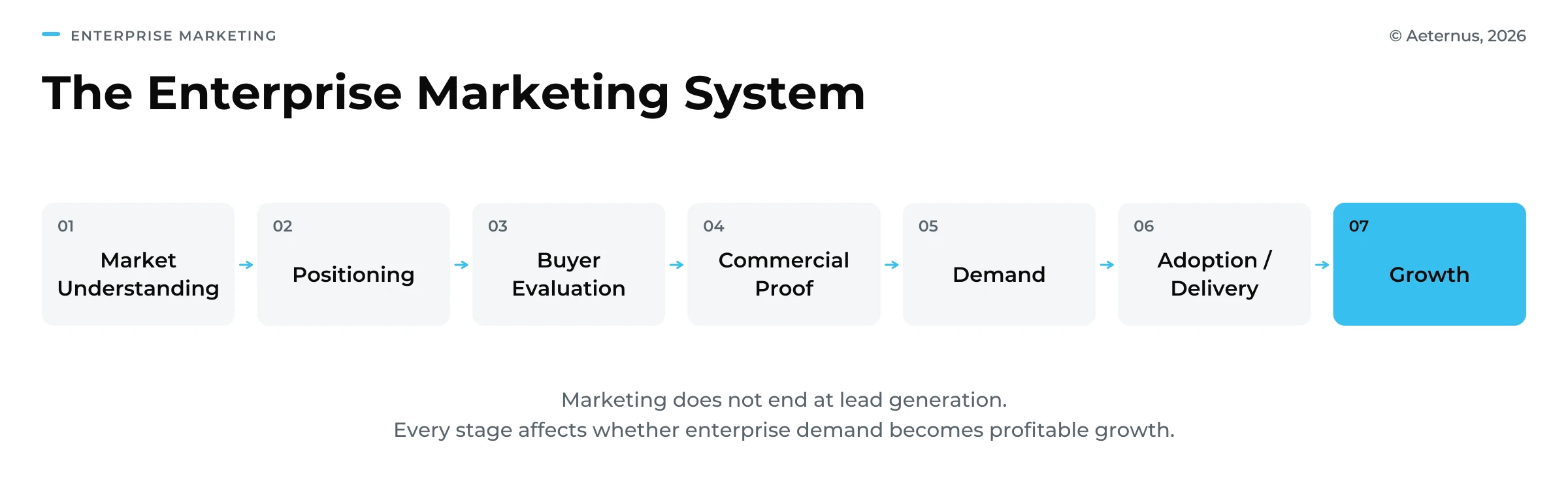
In this article
Software product strategy
- Customer problem
- Self-service evaluation
- Channel continuity
- Buying group
- Thought leadership
- Global expansion
- Adoption
IT services strategy
- Responsibility model and European sourcing
- Delivery credibility
- Insourcing competition
- Global delivery
Across both business models
- Research gaps and growth constraints
- What happens next
Selling software products
Choose the customer problem you can credibly own
For a company selling software products, enterprise marketing begins with a choice about relevance. A list of industries, company sizes and job titles is only the beginning of an ideal customer profile.
More useful questions focus on the situation inside the account:
- What has become expensive or difficult?
- What event makes action timely?
- Who owns the problem?
- What systems must remain in place?
- What would justify the disruption of introducing another platform?
A workflow product, for example, could address manual reporting, inconsistent approvals or slow case resolution. Those problems involve different stakeholders and evidence. A campaign that bundles them into a promise to improve efficiency gives the buyer little help deciding whether the product fits.
What we do here is choose a small number of use cases where customer need, product strength and credible proof overlap.
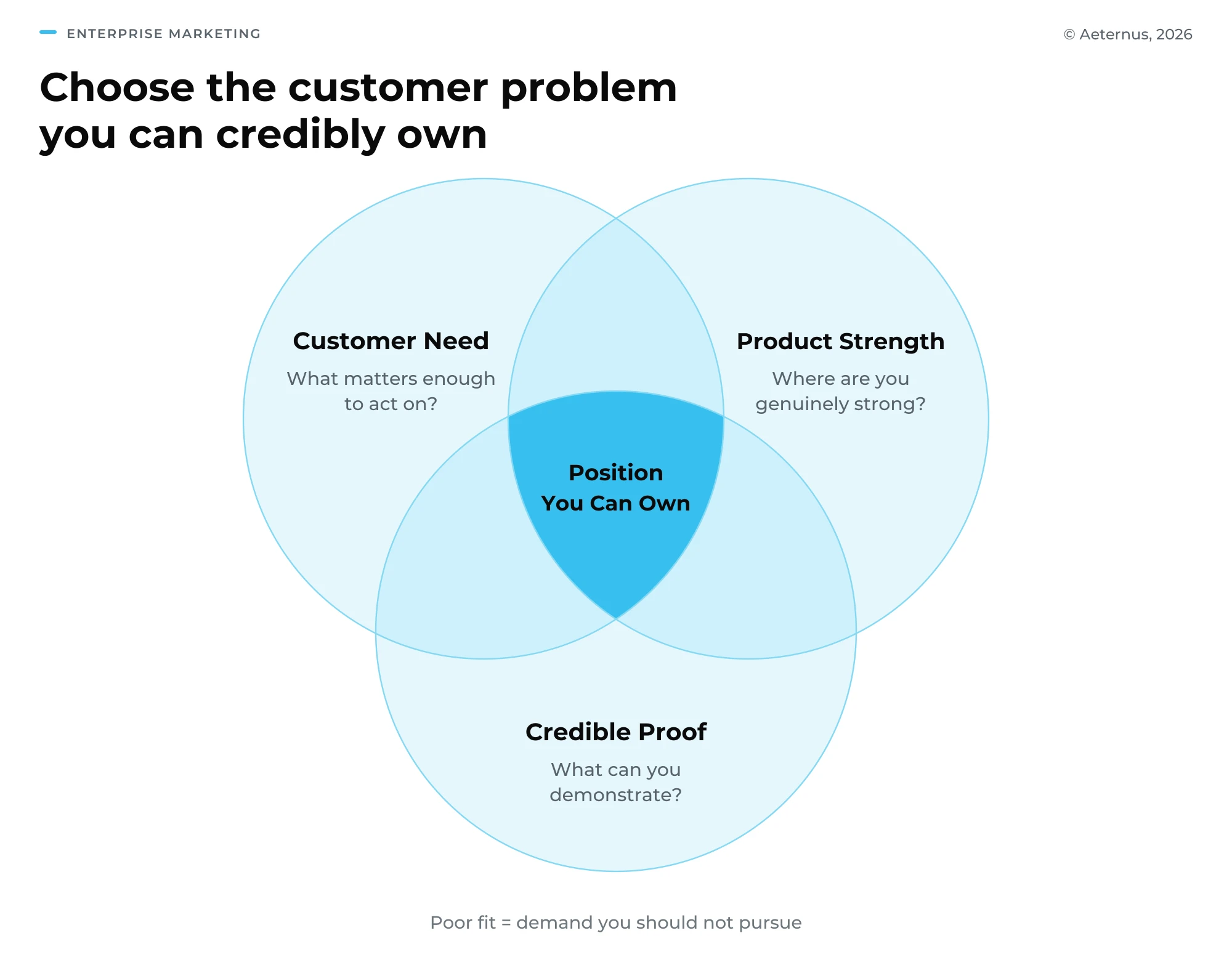
Then, we define the operational change, the conditions for success and the alternative the buyer is using today. That alternative may be a spreadsheet, an incumbent platform, an internal build, or simply a tolerable inconvenience.
This is also where to define poor fit. An enterprise contract that requires extensive custom development, unsupported integrations or unusually costly service may increase revenue while weakening the business.
Marketing should attract customers whose needs the company can serve sustainably.
Commercial implication: Agree which customer problems the business can credibly solve and which opportunities it should decline before investing in broader demand generation.
Help buyers evaluate before they speak to sales
Once the customer problem is clear, buyers need a practical way to assess your answer to it. A suitable account should be able to understand the product and judge whether it deserves closer evaluation before speaking to sales.
Gartner’s March 2026 Sales Survey found that 67% of B2B buyers preferred an experience without a sales representative. As buyers progress through the buying process more autonomously, the quality of independent evaluation becomes a serious commercial concern.
Technology purchase research adds a more specific signal. TrustRadius’s 2026 Buying Disconnect study reported that 83% of buyers shortlisted three or fewer products, while 74% used peer reviews to inform purchase decisions. Transparent pricing remained the leading buyer request, and the disconnect between buyer behavior and vendor strategy is evident.
For Aeternus, this means making evaluation easier and more useful. Although discovery tools have changed, buyers still don’t fully trust vendor collateral. Yes, your website should help a suitable buyer answer practical questions: what the product does, who it is built for, how it works with existing systems, what implementation involves and how the commercial model operates. But real, use-case-specific insights from people who have actually used the product are still the primary driver. Give buyers enough outside information to judge whether a conversation is worthwhile. Requiring a meeting for every basic answer adds work before you have established value.
If your product can be explored safely, offer a meaningful demo, sandbox or trial. For a platform requiring integration and sensitive data, a guided evaluation coupled with mock data and agreed success criteria may be more useful. The choice should reflect how the customer can assess the product accurately.
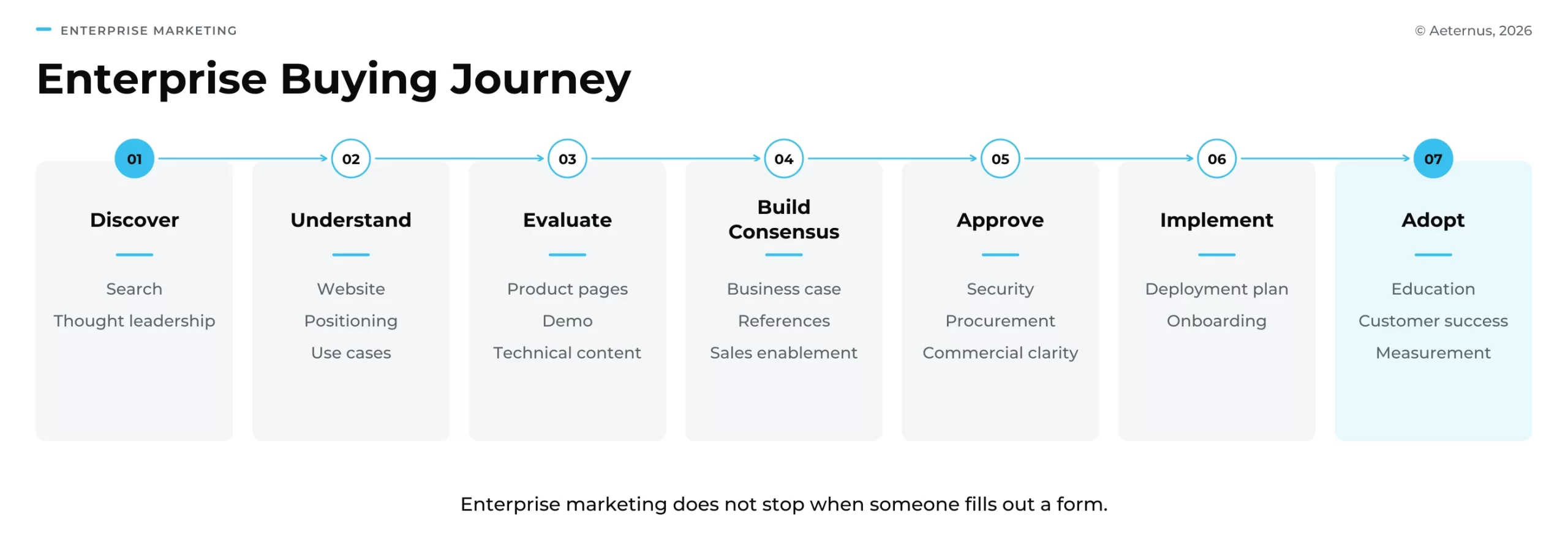
Commercial implication: Assess the website by how well it helps suitable accounts evaluate fit and prepare for a useful sales conversation.
Connect digital discovery with useful human involvement
Independent evaluation and human involvement need to work together. Buyers should be able to move between them without rebuilding the conversation each time.
McKinsey’s 2024 B2B Pulse research found that buyers used an average of ten interaction channels. Preferences were broadly distributed across in-person, remote and digital self-service interactions. It also found that 41% preferred in-person interaction when dealing with a new supplier.
The strategic task is to give each channel a job. Press releases can attract attention. Search and specialist content can introduce the problem and capture active research. Product pages and demonstrations can support evaluation. Customer references and technical sessions can help resolve uncertainty. Account activity can guide relevant follow-up where there is a credible reason to engage.
The handovers also matter within the customer journey. Someone who has already reviewed an integration guide should be able to discuss their architecture without repeating an introductory qualification call. A buyer moving from an event to a website to a sales conversation should encounter the same capabilities and commercial promise.
Gartner’s 2025 Sales Survey found that 69% of surveyed buyers encountered inconsistencies between website information and sales representatives. It also reported that 73% avoided suppliers sending irrelevant outreach.
That gives marketing and sales a concrete shared task: maintain an accurate explanation of the offer and a defensible reason for contacting an account.
Commercial implication: One top priority is to review handovers between channels alongside channel performance. A productive interaction loses value when the next one introduces confusion or unnecessary repetition.
Give the buying group a case it can agree on
Continuity must extend beyond the person speaking to your sales team. A strong demo may convince an operational champion while leaving finance, security and procurement unconvinced. These stakeholders face different consequences from the same decision.
Gartner also reported that 74% of B2B buying teams demonstrated unhealthy conflict during decisions, including conflicting objectives, disagreement and decisions being overridden.
Our approach is to build a common business case, then give each participant the evidence they need to assess it. The following table is a practical starting point, but needs to be adapted through customer interviews.
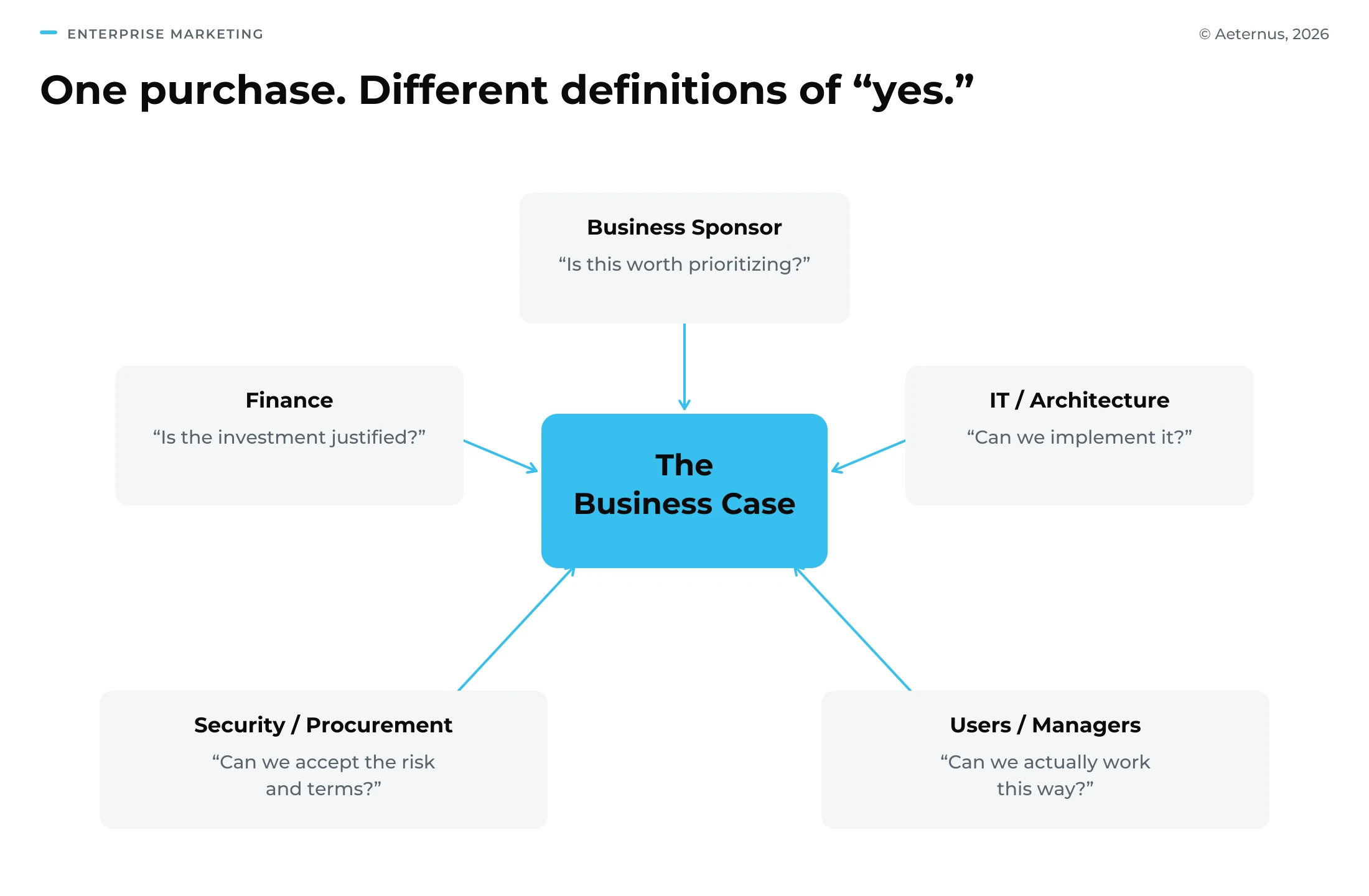
These materials should describe one coherent proposition. Promising maximum flexibility to users while presenting a tightly standardized implementation to IT can create disagreement the other party must later resolve.
Give the customer something they can circulate: a concise business case, an implementation outline and a clear account of the trade-offs. Useful sales enablement reduces the amount of interpretation required inside the customer’s organization.
Commercial implication: Equip the buying group to assess one consistent business case. Each stakeholder needs relevant evidence, while the underlying promise stays the same.
Make your expertise useful to people you may never meet
Some of the people shaping that business case may never join a sales call. Your content needs to be useful enough to reach them through the account.
Enterprise content should help a buyer think through a consequential decision. A feature announcement has a place, but a well-evidenced explanation of migration risk, integration choices, or the economics of replacing a legacy process may travel further inside an account.
The 2025 Edelman and LinkedIn thought leadership research found that 79% of hidden buyers said they were more likely to push through a supplier during an RFP when it consistently produced high-quality thought leadership.
A useful editorial program therefore starts with questions that delay or reshape purchases. Publish an informed answer, show the assumptions behind it and explain where the product fits. An article acknowledging that migration may be unnecessary in some circumstances can help establish the judgment required for a larger decision. Above all, grabbing buyer attention, even when they’re not actively reviewing your services, is a successful long–term strategy.
AI-assisted research also raises the importance of verifiable material. In the TrustRadius study, 63% of buyers used AI in their research; among those users, 94% checked its outputs at least sometimes. This trend requires you to maintain clear documentation, attributable expertise and current evidence that someone can verify after receiving an AI-generated answer.
Commercial implication: Build the editorial program around decisions customers struggle to make. Its value increases when people can use the material in internal discussions without your team present.
Build a global strategy around markets you can actually serve
The same need for relevance applies when you enter another market. A convincing proposition in one country still needs to fit the conditions in which another customer will buy, implement and use it.
Global product marketing requires a repeatable core and informed local decisions, while keeping the product’s essential promise and evidence standards consistent. Adapt use cases, language, references, buying routes and implementation explanations to the market you’re entering.
Evaluate a country alongside a target industry and customer problem. A large national software market does not tell you whether a particular segment needs your product, can purchase it, or can adopt it at an attractive cost to you.
Before committing substantial campaign spend, assess four questions.
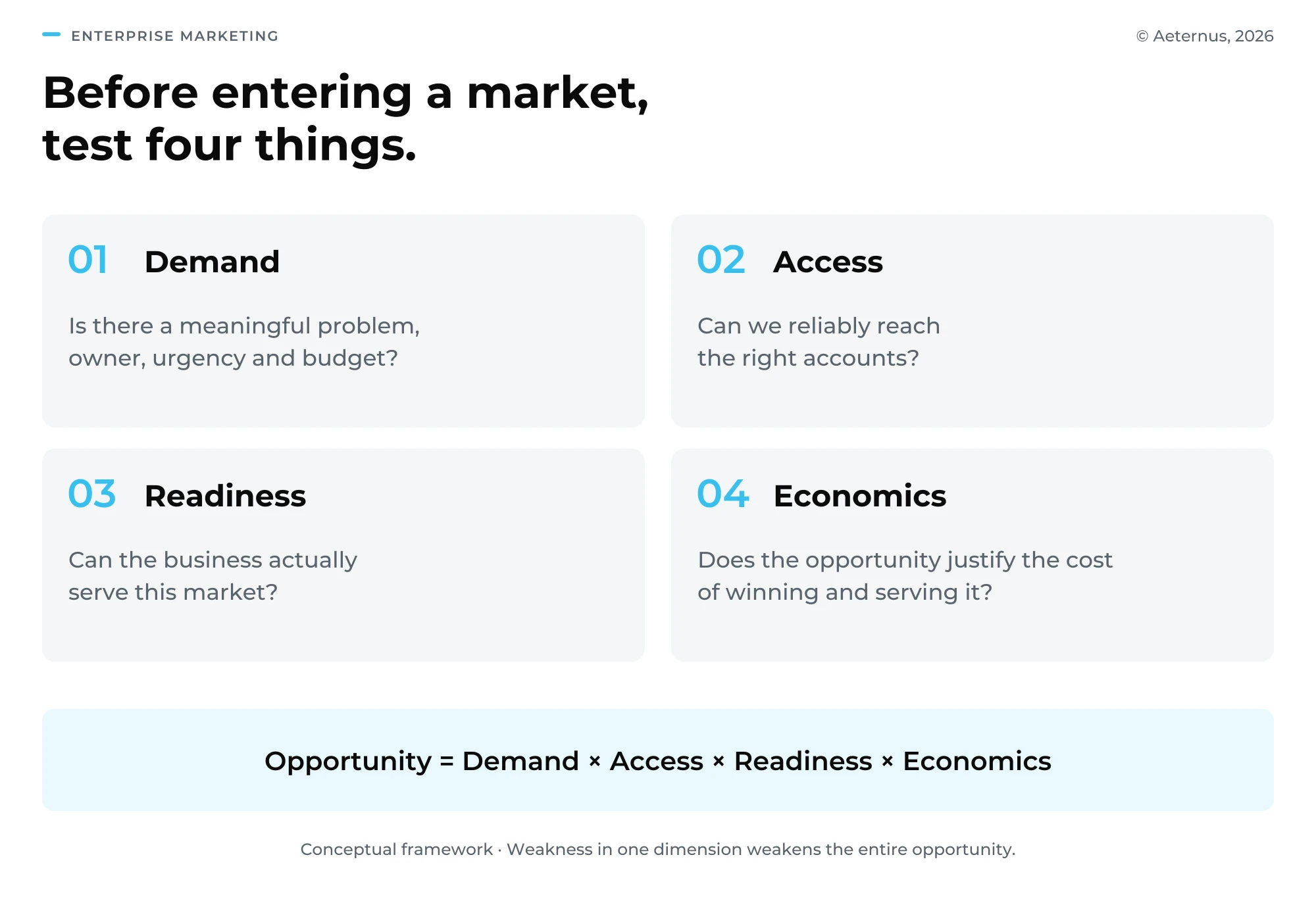
Localization includes the experience after a buyer responds. A translated landing page will disappoint if the demonstration, procurement discussion and onboarding revert to unsupported assumptions about language, integrations or support hours.
That’s why running a focused market pilot with an explicit budget and review date is a good way to proceed. Test whether appropriate accounts engage, whether opportunities progress and what additional work is required to win and support them. Expand when the evidence supports the next commitment.
Commercial implication: Approve expansion against demand, access, readiness and economics together. Market size alone cannot establish whether entering a segment will produce profitable growth.
Treat adoption as part of the commercial promise
Entering the right market and winning the right account still leaves an important question: can the customer achieve the result you have promised?
An important gap in buying research is the distance between choosing technology and realizing its value. Gartner’s CIO and Technology Executive Survey found that, on average, 48% of digital initiatives met or exceeded their business outcome targets.
For a software company, the practical question is whether the customer has the conditions needed to achieve the advertised outcome. Who owns implementation? Is the data usable? Can the team change its process? Has anyone agreed on how success will be measured?
Make those conditions visible during evaluation. A pilot should have a business owner, a baseline, a decision date and a route into production. Include the customer’s effort in the business case. A successful technical demonstration does not prove the organization is ready for deployment, especially if outcomes misalign with financial impacts and C-suite alignment.
Marketing should then learn from onboarding, usage and renewals. Track qualified pipeline and acquisition cost alongside time to initial value, adoption of the intended workflow and retention by customer segment. Those measures can reveal whether the positioning attracts customers who become successful users.
For product companies, this is where Aeternus’s work on customer intelligence, positioning, demand generation and marketing operations connects. We can help clarify the customer promise, organize the evidence supporting it, and build a marketing program around the segments the business can serve. Product and customer success teams remain essential partners in validating that promise.
What this means for leadership: Connect acquisition decisions to adoption and retention. A product marketing strategy should help the business attract suitable customers, support their evaluation and set expectations the product and customer success teams can fulfill.
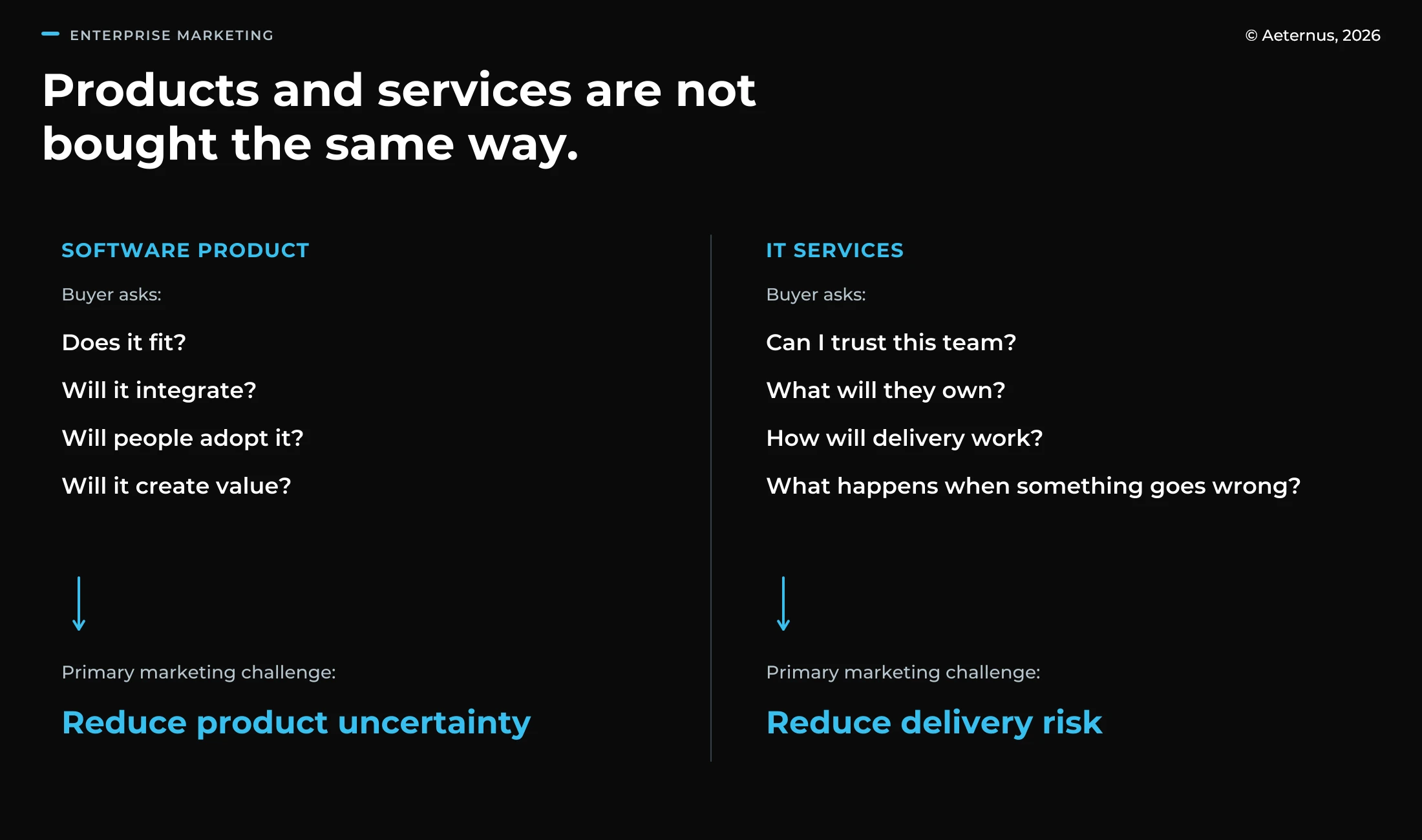
Selling software development and IT services - explain your responsibility
For development and IT services companies, buyers must assess how future work will be delivered and who will be responsible for it. Talent constraints create a reason to explore external support, but not every organization wants the same delivery model.
Read the European sourcing opportunity carefully
Our starting point is the customer’s specific need for outside support. Hiring difficulty, external spending and internal capability all help explain the market, but they do not describe one uniform opportunity.
Eurostat reported that 57.5% of EU enterprises attempting to hire ICT specialists in 2023 struggled to fill vacancies.
The survey also found that 83.3% of large EU enterprises used external suppliers for ICT functions, while 87.2% relied on their own employees. These figures can overlap: external support and internal capabilities coexist.
Whitelane’s 2025/2026 European IT Sourcing Study shows that among over 2,500 organizations, 30% planned to increase external IT spending, 35% expected no change, 20% anticipated cuts, and 15% were unsure over the following two years.
Your strategy should focus on opportunities where organizations need specialist skills or flexible capacity, even if they are reducing overall spending. Your market depends on specific scope and priority, not just the overall IT budget trend.
Commercial implication: Identify the work customers need external help to complete. Broad sourcing trends provide context; the specific responsibility you can accept defines the opportunity.
Make the engagement model explicit
A services website built around technologies and broad capabilities leaves much of the buying decision unexplained. Buyers also need to understand what responsibility the supplier will accept and what the customer must provide.
Describe your offer around a recognizable situation. Examples might include modernizing a business-critical application while maintaining service, helping a product team clear a release bottleneck, or taking responsibility for operating a defined environment. These are illustrative positioning choices; the right one depends on your actual experience and capacity.
Make the engagement model explicit because it changes the customer’s workload and risk.
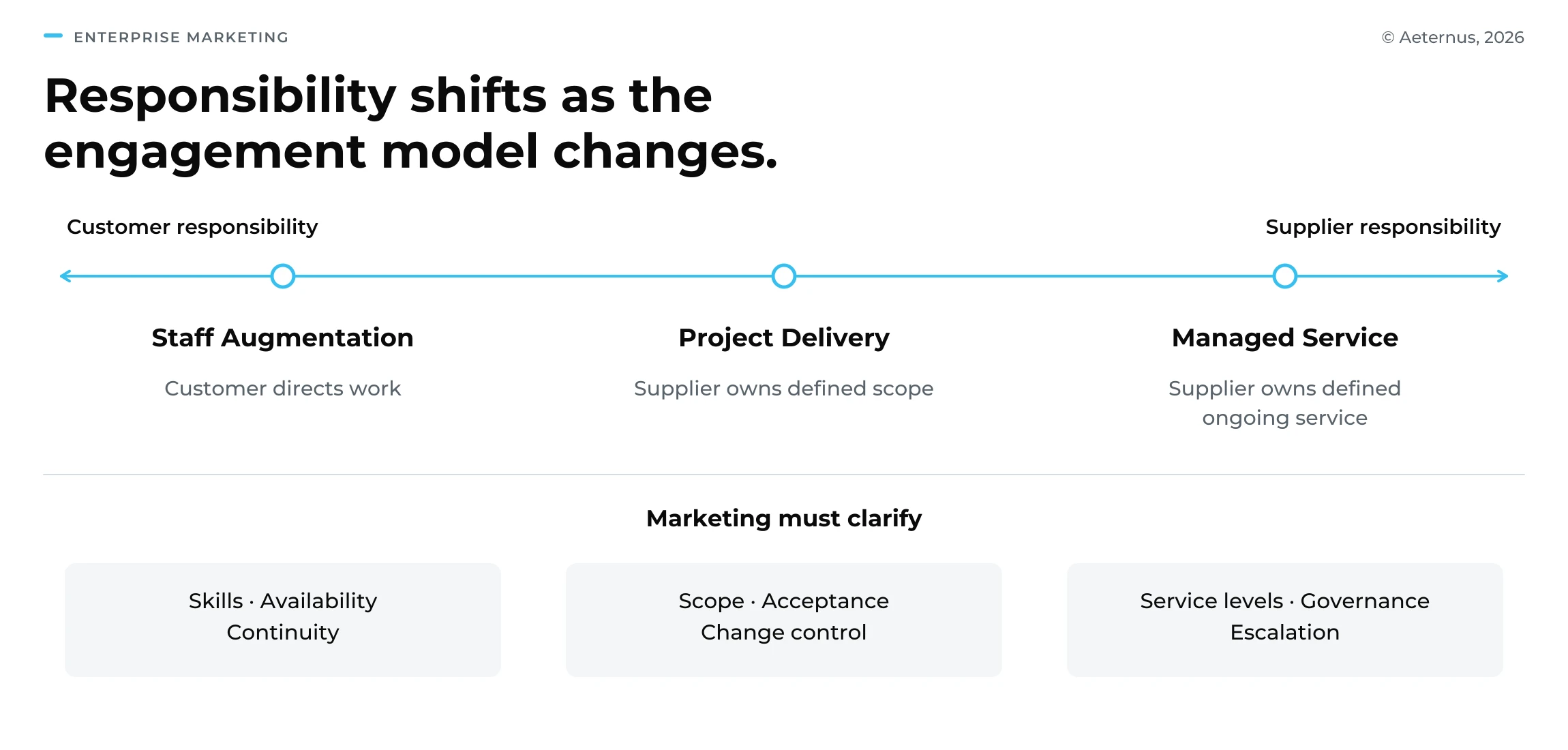
Hybrid arrangements can work in many cases. However, you need to resolve ambiguity before the proposal becomes a contract.
An outcome-based commercial model requires a measurable result and enough supplier control over the factors that produce it. Otherwise, the headline promise can conceal a disagreement about accountability.
At Aeternus, the end goal is to make these distinctions understandable to the right buyers. That requires input from delivery leaders and the commercial team. A compelling proposition must reflect how the work will actually be organized.
Commercial implication: Agree the responsibility boundary before promoting the offer. Marketing, sales and delivery should describe the same scope, customer obligations and basis for accountability.
Demonstrate judgment and delivery credibility
Once the responsibility is clear, the buyer needs evidence that your team can handle it. Technical capacity must be accompanied by judgment and an understanding of the customer’s circumstances.
The Whitelane research mentioned above identified weaknesses buyers saw in service providers: 38% cited insufficient challenge to the client’s thinking, 30% cited inexperienced resources, and 27% cited insufficient business or industry knowledge.
Addressing those concerns means making your team’s thinking visible. Show how it approaches a difficult decision. Explain the alternatives considered, the constraints that mattered and the consequences of the choice.
A migration case study can address continuity and rollback planning. An engineering case study can explain how the team identified the cause of delivery delays and measured improvement.
For each published result, state the starting point, scope, timeframe and contribution your team made. Make a distinction between an observed customer outcome and an estimate. If confidentiality restricts disclosure, agree an anonymized version, a private reference conversation or another permissible form of evidence with the client.
Also, make delivery governance tangible. Buyers should understand who leads the work, how continuity is managed, how risks are raised and how decisions are documented.
Relevant secure development practices can form part of that explanation. For example, NIST’s Secure Software Development Framework provides a recognized vocabulary for discussing development security between purchasers and suppliers; it is guidance, rather than a universal certification.
These materials also help your sales team avoid making every conversation depend on a founder or senior engineer recalling the company’s expertise from memory.
Commercial implication: Make expertise transferable through case studies, references and clear delivery explanations. Buyers need evidence of how the team makes decisions and manages the work.
Account for insourcing and changing customer capabilities
The competitive landscape also includes the customer’s own team. A credible services proposition needs to explain how external support fits with the capabilities the customer wants to retain or develop.
Deloitte’s 2024 Global Outsourcing Survey found that 80% planned to maintain or increase outsourcing investment. It also reported that 70% had selectively brought previously outsourced work in-house during the preceding five years.
Both can fit within the same sourcing strategy. One customer may want external expertise for a migration while retaining architecture decisions internally. Another may need temporary capacity and a deliberate knowledge transfer. A third may prefer a managed service with a clear exit arrangement.
Marketing can address these preferences directly through distinct use cases and relevant pages. These are different customers with different needs, so explain how you work with internal teams, which capabilities you help develop, and how documentation and handover work.
A supplier that makes collaboration and future independence understandable gives buyers a clearer basis for assessing the relationship.
AI adds another question: what value does the customer receive as software production methods change? Claims about faster coding need to be connected to the work as a whole. Agree on how you’ll assess delivery speed, quality, operating cost or another relevant outcome. Explain review practices and responsibility for the resulting software.
This situation also affects your own economics. If clients expect productivity gains, a proposition based entirely on supplying more hours becomes harder to defend. The answer depends on the engagement: specialist judgment, responsibility for a defined service or demonstrable progress towards an agreed result.
Commercial implication: Explain how your offer complements the customer’s internal capability, including knowledge transfer and handover. Make the value of your involvement clear as delivery methods change.
Build global demand around delivery reality
That relationship between the customer’s needs and your responsibilities should also guide international expansion.
Nearshore positioning can explain practical advantages such as overlapping working hours. Buyers still need to evaluate whether a provider understands their environment and can deliver the proposed work.
Service providers can select markets by matching demand with delivery capability. Consider the availability of relevant references, access to decision makers, procurement expectations, language coverage, travel needs, working hours and the cost of servicing the relationship.
For cross-border work, review data handling and contractual requirements with the appropriate specialists before turning them into marketing promises.
Country comparisons can draw on sources such as the OECD’s Services Trade Restrictiveness Index and its digital trade indicators. These help identify regulatory conditions worth examining; they do not measure demand for your company or replace a review of the proposed engagement.
Keep a common company narrative while adapting the evidence and route to market. One segment may be reachable through an existing technology partner, another through a specialist industry network. Local references may answer concerns that a translated global case study leaves unresolved.
Coordinate marketing with capacity planning. Generating demand for a specialist team that cannot start when needed has little commercial value. The campaign plan should specify the work you want, delivery locations, and when the appropriate people will be available.
Measure opportunity quality by scope fit, contribution margin, start-date feasibility, customer concentration, and revenue. A big contract may be unattractive if it creates an unsupported dependency or assigns scarce specialists at low margins.
What this means for leadership: Connect services marketing to delivery planning and commercial economics. Growth depends on winning suitable work that the business can staff, govern and deliver at an acceptable margin.
Investigate the decisions that buying surveys leave out
Across both business models, understanding completed purchases answers only part of the commercial question.
Research on recent technology purchasing decisions, such as the TrustRadius study mentioned above, helps explain selection. Your research should also examine what happens to accounts that postpone, reduce or abandon the investment.
For both product and service companies, this gap is worth researching and addressing. Speak with recent wins, losses, stalled opportunities and existing customers. Ask what created the original need, who became involved, which alternatives were considered and what made action possible or impossible.
Treat a CRM label such as “budget” as the beginning of an investigation. It could mean an unaffordable proposal, an unclear return, competing priorities or no agreed owner. Each calls for a different response. More traffic will not resolve all of them.
A second gap remains: aggregate research cannot establish the best channel mix or spending level for your company. Its role is to refine hypotheses you can test with your customers and commercial results.
Define those tests clearly. Compare outcomes among account groups, use a holdout when possible, and record changes. Review sales conversations alongside the data.
A campaign may generate fewer inquiries but still improve the business if it attracts better-fit work that converts and is profitable.
Commercial implication: Investigate why suitable accounts fail to progress before increasing acquisition spending. The answer may concern positioning, evidence, internal priorities, evaluation friction or delivery fit.
Research scope and methodology
The research supports the argument while covering different populations, periods and buying situations. These distinctions matter when applying the findings:
Gartner’s 2026 buying research
The rep-free preference finding came from 646 B2B buyers surveyed in August and September 2025. It describes a broad preference, rather than establishing that every complex purchase can proceed without human involvement.
TrustRadius’s 2026 Buying Disconnect study
The study surveyed 1,862 technology buyers and 444 vendors globally. It is a commercial research program associated with a review platform, so its findings should inform customer research rather than serve as universal conversion benchmarks. The AI fact-checking figure refers to buyers who used AI.
McKinsey’s 2024 B2B Pulse
The research covered nearly 4,000 decision-makers across 13 countries. Its channel findings support continuity; they do not prescribe ten channels for every vendor or an equal budget split.
Gartner’s 2025 outreach and buying-group findings
Both draw on the same 632-buyer survey conducted in 2024. They offer different analyses of one sample, rather than independent corroboration.
Edelman and LinkedIn’s 2025 research
The study surveyed 1,934 US business decision-makers. It measures reported attitudes, rather than proving that publishing content causes a particular win rate.
Gartner’s 2025 CIO and Technology Executive Survey
The research gathered responses from 3,186 CIOs and technology executives in 88 countries, supplemented by 1,126 leaders outside IT. It concerns digital initiatives broadly. Falling short of an outcome target does not establish that an initiative delivered no value or that marketing caused the shortfall.
Eurostat’s ICT findings
The 2024 survey covered businesses with at least ten employees in selected sectors and reported on 2023. The hiring figure concerns enterprises attempting recruitment. The sourcing figures can overlap and do not imply that entire IT departments were outsourced.
Whitelane’s European sourcing research
The study covers Europe beyond the EU. The spending figures reflect intentions, not realized growth.
Deloitte’s outsourcing research
The survey covered more than 500 executives. Future investment plans and selective insourcing over the preceding five years concern different periods and can coexist.
Turn the strategy into decisions and accountable execution
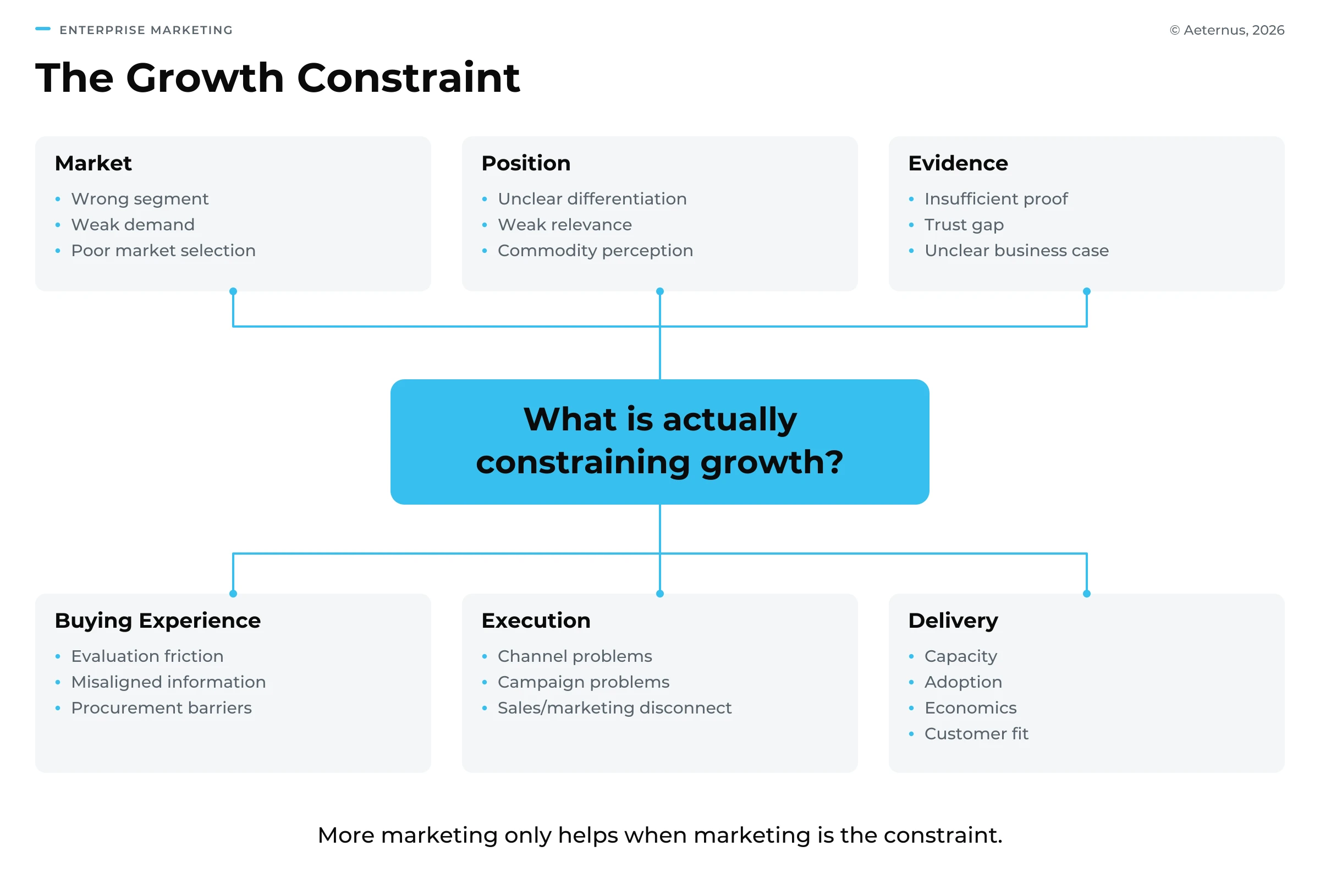
The commercial problem may be unclear positioning, missing evidence, poor market selection, or a buying journey that creates avoidable friction. Before committing to larger marketing efforts, identify which problem limits progress.
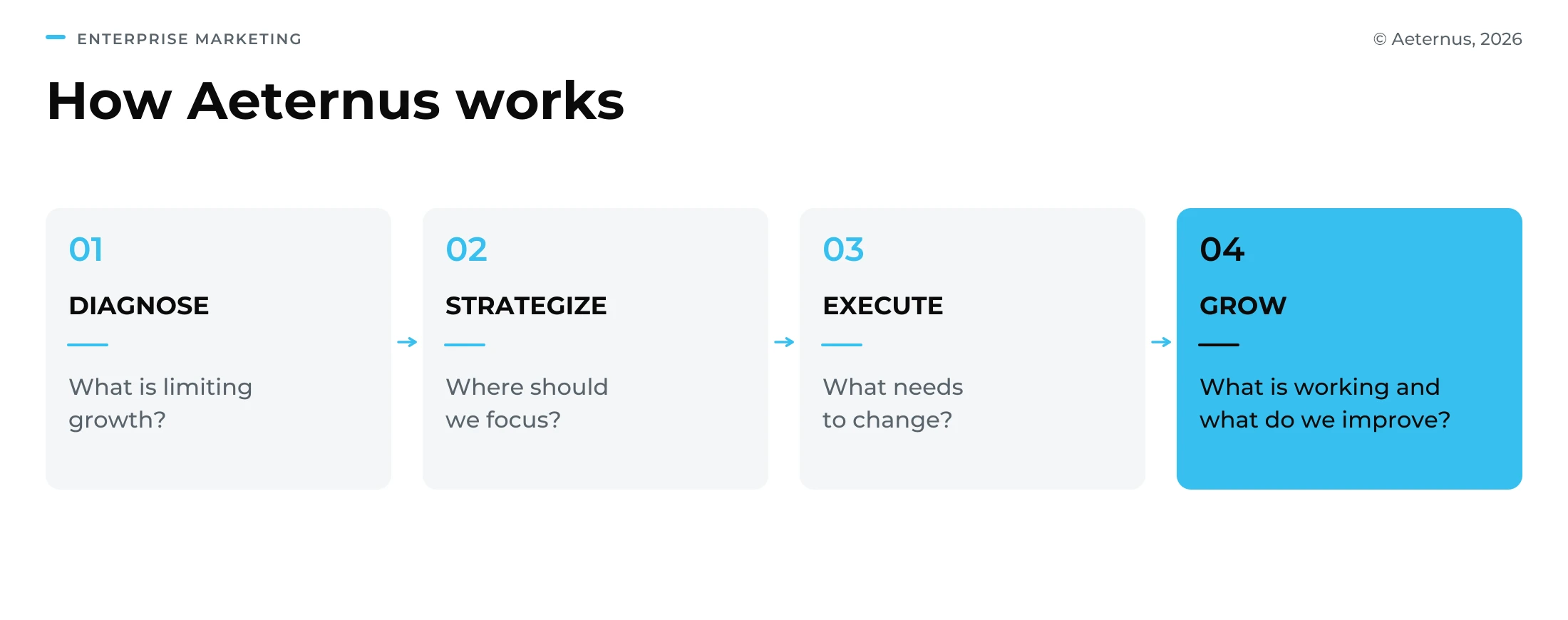
This is the logic behind Aeternus’s approach: Diagnose, Strategize, Execute, Grow.
Starting with the business and its customers, we identify priorities, carry out the agreed work, and review performance to determine what needs to change.
Establish the priorities
The initial 90 days may begin with customer and opportunity research, a positioning review, and agreement on the segments worth pursuing. These decisions give the team a basis for choosing what to improve first.
Turn those priorities into useful work
The next phase focuses on the website pages, sales materials and campaign assets needed to support those decisions. A focused launch then tests the offer and channel choices, with assigned owners and regular commercial reviews.
The sequence follows the diagnosis and the team’s capacity.
Connect performance to the business model
For products, connect acquisition to adoption and retention. For services, link pipeline to delivery fit and profitable capacity.
Both need a shared definition of a qualified opportunity and a way to learn why deals progress, stall or disappear.
Aeternus offers fractional marketing leadership or combined leadership and execution across research, positioning, content, search, campaigns, and marketing operations. The scope depends on the company’s existing strengths and where additional ownership is needed.
If your capabilities have outpaced your market position, or marketing activity is producing too little commercial clarity, the first step is to identify the constraint.
Aeternus’s Growth Diagnosis Sprint examines that problem, establishes priorities for the following 90 days, and provides an executive readout to guide improvements.
What this means for leadership: Begin with a clear diagnosis, assign ownership to the resulting priorities, and judge execution against the commercial outcomes the business needs.