

How to build brand loyalty
- Published: 11/09/2026
- 18 minutes read

How to build brand loyalty
- Published: 11/09/2026
- 18 minutes read
Introduction
Most companies begin thinking about loyalty after the first purchase. They introduce a rewards program, build a lifecycle email sequence, offer a renewal discount or invite customers into a community. These initiatives can influence behavior, for example, repeat visits or repeat attention. But by the time they appear, most of the conditions that determine loyalty are already in place.
The customer has already learned whether the company is easy to understand. They have decided whether its promises are credible. They have experienced whether the product delivers what the marketing suggested it would deliver. They have also discovered how much effort it takes to buy, use, renew or leave.
A loyalty program can reinforce the conclusions customers form through these experiences. However, it cannot reverse them.
This is why loyalty should not be treated as a campaign, channel or isolated customer-retention tactic. Brand loyalty is an outcome of a larger system: what customers remember, what they expect, what the company delivers and whether choosing it again feels worthwhile.
To build that system, companies first need to understand what kind of loyalty they have and what may be preventing it from strengthening in customers’ minds.
Repeat purchasing is not always brand loyalty
The word loyalty describes several different customer behaviors. That creates a serious measurement problem.
A customer who repeatedly buys the same brand may genuinely prefer it. They may also buy it because it is the easiest option, because the alternatives are difficult to evaluate or because switching would be expensive. From a revenue perspective, these customers can look identical. Psychologically, they are not.
Alan Dick and Kunal Basu described loyalty as the link between relative attitude and repeat patronage. Their framework clarifies four conditions that companies often confuse or blend together:
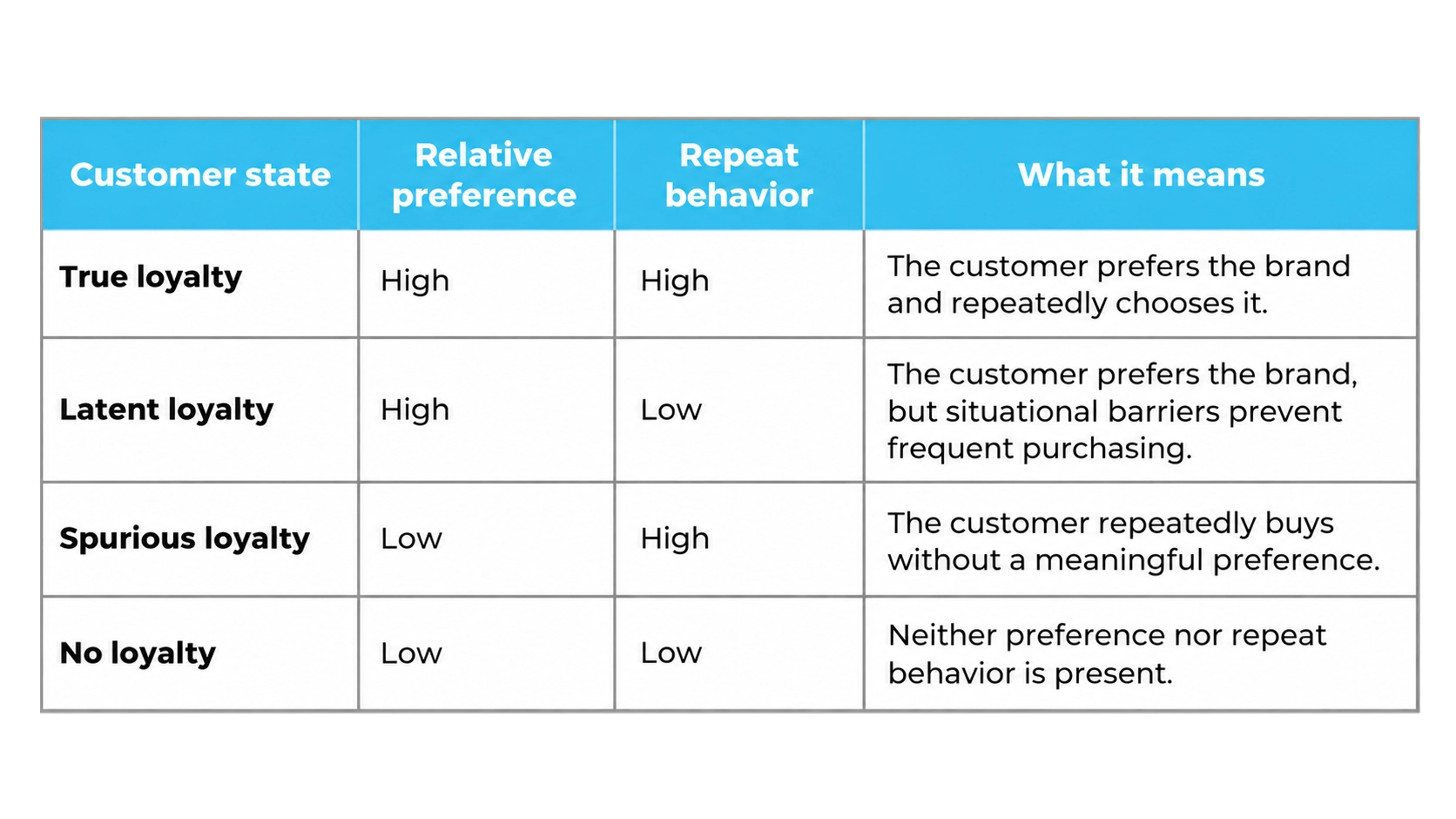
This distinction matters because every condition requires a different response. Someone with latent loyalty may need better availability, easier purchasing or a more suitable offer. Someone displaying spurious loyalty may remain only until a more convenient alternative appears. A genuinely loyal customer may still leave if the experience deteriorates badly enough.
For B2B companies, the situation is often more complex. The end user might love the product, but the buyer may see it as replaceable. A procurement team might renew a contract to avoid disruption, even if users are unhappy. Conversely, users may wish to keep the product, while new leadership replaces it as part of broader tech changes. Essentially, retention shows who stayed, but it doesn’t reveal the reasons for staying or leaving.
Loyalty develops in stages
Richard Oliver’s paper, “Whence Consumer Loyalty?“, describes loyalty as something that can develop through four stages:
- Cognitive loyalty: The customer believes the brand performs better on attributes that matter.
- Affective loyalty: Repeated satisfactory experiences create positive feelings toward it.
- Conative loyalty: Preference becomes an intention to buy or continue.
- Action loyalty: The customer acts on that intention and overcomes obstacles to repurchase.
The model highlights that satisfaction matters but isn’t enough on its own. Customers may be satisfied with multiple competing products, which can prevent them from leaving, but this doesn’t necessarily give them a compelling reason to choose one brand over another.
That gap is exactly where many loyalty strategies fail. Companies attempt to strengthen the final behavior without understanding the beliefs, experiences and intentions that precede it.
Brand loyalty begins before the customer buys
Loyalty is usually discussed as a post-purchase phenomenon. Yet, the conditions that support it begin much earlier.
Before someone can repeatedly choose a brand, they must notice it, remember it and understand what it represents. Essentially, customers need to understand the brand’s positioning, messaging, and relevance. Therefore, a company must establish an expectation that the product or service can later confirm.
Kevin Lane Keller’s customer-based brand equity model explains brand equity through the knowledge held in a customer’s memory. Strong brands become familiar and accumulate favorable, strong and sufficiently distinctive associations. Those associations help customers answer important questions:
- What is this company known for?
- In which situations should I consider it?
- What makes it relevant to me?
- How is it different from the alternatives?
- What outcome should I expect?
If the answers are weak or inconsistent, every new decision requires more mental effort. The company may have satisfied customers without owning a clear position in their minds.
The Ehrenberg-Bass school adds an important counterweight to the idea that brands grow primarily by creating unusually devoted customers. The empirically observed Double Jeopardy pattern shows that smaller brands tend to have far fewer buyers, and those buyers are usually slightly less frequent purchasers. Much of the apparent difference in loyalty between brands is therefore connected to market penetration and brand size.
The implication is not that loyalty is irrelevant. It is that companies should not pursue loyalty while neglecting acquisition, availability and brand memory. A brand cannot become easy to choose again if it was never easy to recall or buy in the first place.
The six conditions that make loyalty possible
No single lever manufactures brand loyalty. Several conditions usually reinforce one another.
1. The brand is easy to remember and access
Customers do not walk around continuously thinking about the companies they buy from. Brands enter consideration when a situation activates a need.
A finance leader may think about payment infrastructure when international fees become a problem. A CTO may consider a development partner when a product roadmap exceeds internal capacity. A driver may begin comparing electric vehicles when fuel costs, regulation or a major repair changes the economics of ownership. The brands connected to those moments have an advantage; this is what we call a timely brand recall.
This is the practical importance of mental availability: the probability that a brand comes to mind in a buying situation. Physical availability concerns whether it can then be found, purchased, implemented or accessed with reasonable ease – all constituent parts of the customer journey.
Companies strengthen these conditions by:
- Consistently connecting the brand to relevant customer problems and buying situations
- Building and protecting recognizable brand assets
- Maintaining coherent language across channels
- Appearing in the places customers use to research and validate decisions
- Removing unnecessary purchasing and implementation friction
- Making the brand recognizable even when the company name is not prominent
Distinctive assets, such as colors, shapes, sounds, typography, characters, phrases or other recognizable cues, are not merely decorative. Over time, they help customers identify the brand more quickly. But they need consistent investment. Constantly replacing them in pursuit of novelty can destroy memory built over years.
Availability does not create emotional commitment. It does something more basic and often more commercially important: it makes repeated choice possible. That’s why you must approach rebranding with caution; otherwise, you risk removing the brand from the customer’s mind.
2. The customer understands why the brand is relevant
Awareness without understanding leads to a fragile bond. Customers might know a company but not grasp why they should pick it. This issue is typical in saturated markets where competitors all claim similar advantages like better service, advanced technology, higher efficiency, smooth integration, or superior quality. Without a distinct comparison, customers lack a clear reference point.
Effective positioning reduces this ambiguity. It helps customers understand who the product is for, what problem it solves, why its approach matters and how it differs from available alternatives.
For loyalty, positioning performs two roles.
First, it creates an expectation before the purchase. Second, it gives customers a way to interpret the experience afterward. When a company owns a clear idea, customers can more easily tell whether it delivered on that idea.
When a company owns a clear idea, customers can more easily tell whether it delivered on that idea.
Weak positioning creates a different experience. Customers may be satisfied but unable to explain why the company is preferable. When the next decision arises, competitors are evaluated from almost the same starting point.
Companies should therefore investigate whether customers can independently articulate:
- The problem the company solves best
- The customers or situations for which it is most suitable
- The difference between it and its closest alternatives
- The evidence that makes its claims believable
- The value they would lose if the brand disappeared
If customers repeat the company’s tagline but cannot describe its distinctive value, the messaging may be memorable without being strategically useful.
3. The experience confirms the promise
Branding creates expectations, and experience verifies them, which is why customer experience should not be treated as something separate from the brand. Every interaction provides evidence about what the company really values and how reliably it behaves.
In their study of brand experience, J. Joško Brakus, Bernd Schmitt, and Lia Zarantonello examined sensory, affective, intellectual and behavioral dimensions of experience and their relationship to satisfaction and loyalty.
In practice, the relevant experience extends far beyond advertising and visual identity. It includes:
- The sales process
- Product performance
- Onboarding and implementation
- User experience
- Documentation and education
- Customer support
- Billing and administration
- Renewal conversations
- Complaint resolution
- The way the company behaves when something goes wrong
When a brand promotes simplicity but complicates implementation, its operational experience undermines its message. Similarly, if it claims to be a partner but vanishes after the sale, customers realize that “partnership” was just a sales tactic, not a core value. Conversely, when a company consistently delivers the expected value, customers become more confident in their decisions over time. True consistency isn’t about repeating the same actions exactly but about maintaining reliable expectations while adjusting how services are delivered to suit individual contexts.
4. Consistent evidence reduces risk and builds trust
Trust becomes more important as the perceived consequences of choosing incorrectly increase.
Buying a snack, selecting payment infrastructure and choosing a healthcare technology provider involve very different levels of risk. In technical and regulated industries, customers often need more than a persuasive promise. They need evidence that the company is competent, stable and safe to choose.
The commitment-trust theory of relationship marketing, created by Robert Morgan and Shelby Hunt, emphasizes that trust and commitment are key to successful relationships. Additionally, studies by Arjun Chaudhuri and Morris Holbrook highlight that brand trust and positive feelings towards a brand are linked to both behavioral and attitudinal loyalty.
In the market, trust rarely comes from one claim. It emerges when several signals converge:
- Marketing claims are specific enough to evaluate
- Case studies demonstrate relevant outcomes
- Customers and independent sources validate the company
- Salespeople acknowledge genuine limitations
- Leadership communication remains consistent with company behavior
- The website, product and support experience support the same position
- Mistakes are addressed competently and transparently
These signals are especially important online. Customers can compare a company’s claims with reviews, employee commentary, technical documentation, leadership behavior, community discussions and the experiences of other buyers. A polished website can create an initial expectation, but it cannot sustain trust if the surrounding evidence points elsewhere.
Strong brands do not merely declare their credibility. Instead, they let customers reach that conclusion themselves.
5. Repetition creates familiarity, confidence, and habit
Every successful interaction teaches the customer something. They learn how the product works, how the company responds, whom to contact and what the next purchase will involve. In B2B relationships, that accumulated knowledge may extend across teams, workflows, integrations, procurement requirements and internal approval processes.
This environment makes repeated choice cognitively and operationally easier. Customers do not need to investigate every option from the beginning because past experience reduces uncertainty.
Habit and familiarity can support loyalty, but they should not be confused with customer affection. Nor should they be confused with deliberately obstructive switching costs.
There is a meaningful difference between:
- Staying because a product fits naturally into a workflow
- Staying because the company continues to deliver value
- Staying because another buying process is not worth the effort
- Staying because data, contracts, or technical barriers make leaving prohibitively difficult
All four conditions can produce retention, but only some indicate a healthy customer relationship. Companies that rely heavily on obstruction may achieve impressive short-term retention figures while accumulating resentment and vulnerability. Once a credible alternative removes the switching barrier, the apparent loyalty can disappear quickly. Healthy habits are built through usefulness, familiarity and a low-effort experience, not by trapping the customer in unfavorable environments.
6. Identity, attachment, and community can deepen the relationship
Certain brands hold personal significance for consumers, aiding them in expressing their identity, beliefs, community ties, or aspirations, generating loyalty that goes beyond mere satisfaction with product performance. Research by Susan Fournier on consumer-brand relationships revealed that individuals develop various kinds of bonds with brands, rather than a singular universal connection. Subsequent studies differentiated between having a strong positive attitude towards a brand and forming a deeper emotional attachment.
Identity can also operate at the company level. C.B. Bhattacharya and Sankar Sen examined how identification with a company can satisfy customers’ self-definitional needs. Brand communities can reinforce this connection through a shared consciousness, traditions and a sense of responsibility among members, as described by Albert Muñiz Jr. and Thomas O’Guinn.
For consumer brands, identity might form around taste, status, values or lifestyle. In B2B, it can form around professional identity and a shared way of working. A company does not merely sell software; it may champion a methodology. It does not only provide equipment; it may help customers see themselves as more precise, progressive or capable.
However, emotional attachment shouldn’t be seen as a necessary universal trait. Most customers won’t love every brand, especially in low-involvement categories where buyers split their choices among several acceptable options. Pushing for emotional bonds can lead to overstated purpose statements and artificial communities customers never asked for. Genuine customer meaning naturally creates identity and community, but using it as a substitute for relevance, performance, and availability is inefficient.
The problem with common loyalty initiatives
Most familiar loyalty tactics are not useless. However, they may not always fit the problem, so don’t expect them to do jobs they weren’t designed for.
Loyalty programs reinforce behavior, but do not prove preference.
Rewards can create an additional reason to return, increase purchasing frequency and make progress toward a benefit feel valuable. However, loyalty-program data contains a built-in interpretation problem: customers who already buy more may be more likely to join.
Research has found that programs can affect long-term behavior, but their impact varies between customer groups and contexts. Other work that accounts for self-selection shows why companies should be cautious about attributing all differences between members and non-members to the program itself. The right question is not, “Do members buy more?” It is, “Would these customers have behaved differently without the program?”
For example, offering discounts can trigger additional transactions but may also reduce customers’ willingness to pay the full price. If customers only make repeat purchases during sales, the brand might be fostering offer loyalty rather than genuine brand loyalty. Customers may also feel satisfied with a comparable product. However, if a competitor offers a more accessible, distinctive, less risky, or easier-to-justify alternative, this satisfaction may not secure their next purchase. Effective communities additionally require value exchange among members. A branded forum, Slack workspace, or event series alone does not constitute a community simply because customers are invited. A strong community provides members with reasons to engage with each other, not just with the company.
Brand loyalty problem diagnosis
“How do we make customers more loyal?” is too broad to be an actionable question.
A more useful question is:
What is preventing customers from remembering, choosing, trusting, returning to or recommending this company?
The following symptoms can point toward very different underlying problems:
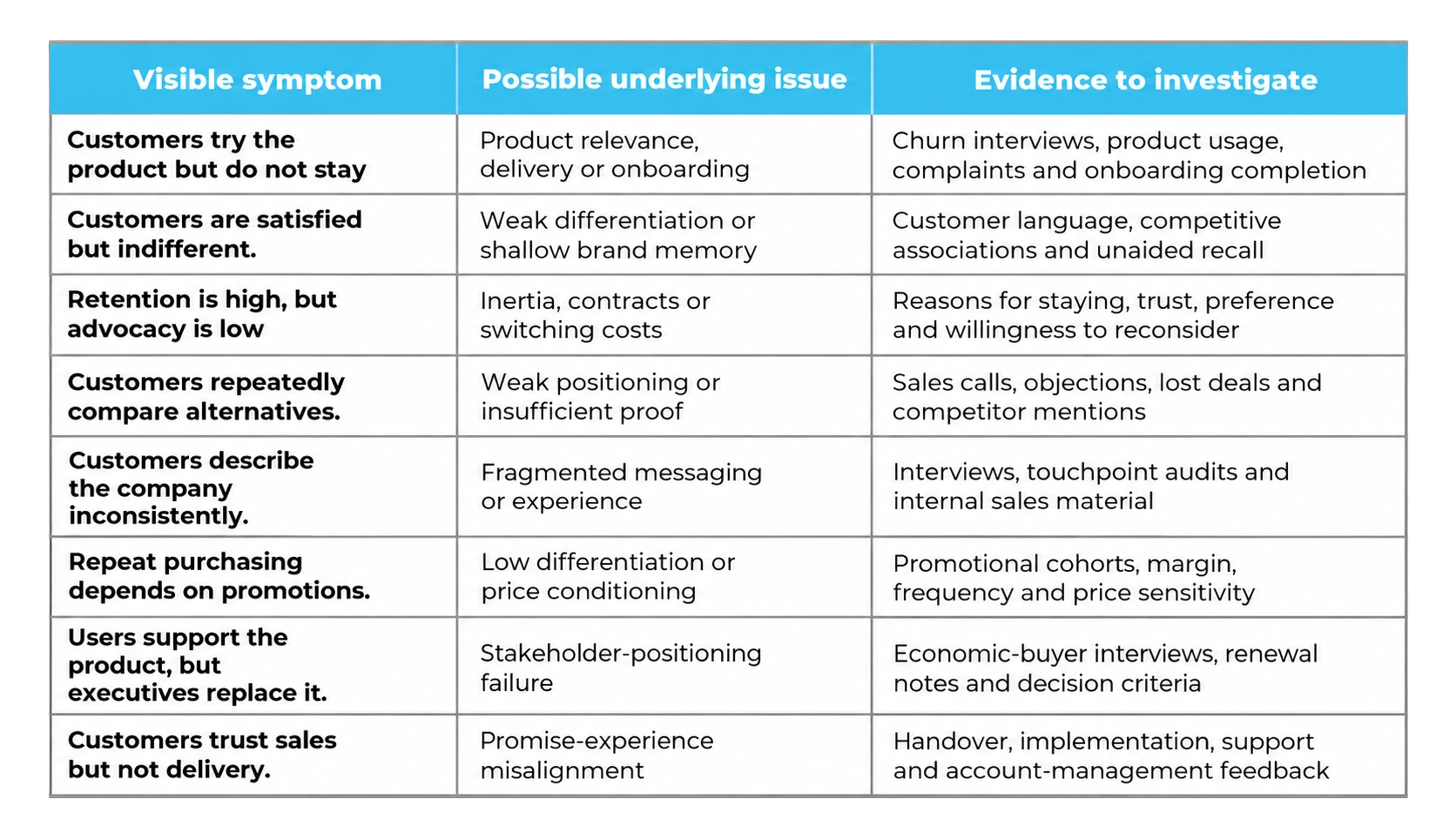
A proper diagnosis should combine behavioral data with customer interpretation.
Behavioral data shows what happened: customers left, renewed, purchased less, stopped using features or rejected an expansion. Research explains why, but interviews reveal how customers understood the experience, what they expected, and which alternatives they considered. Neither source is sufficient alone. Customers may not accurately remember every influence on their behavior, while dashboards cannot explain the meaning they assigned to an interaction.
Measuring loyalty without reducing it to one number
A useful measurement system separates behavior, attitude and commercial outcomes.
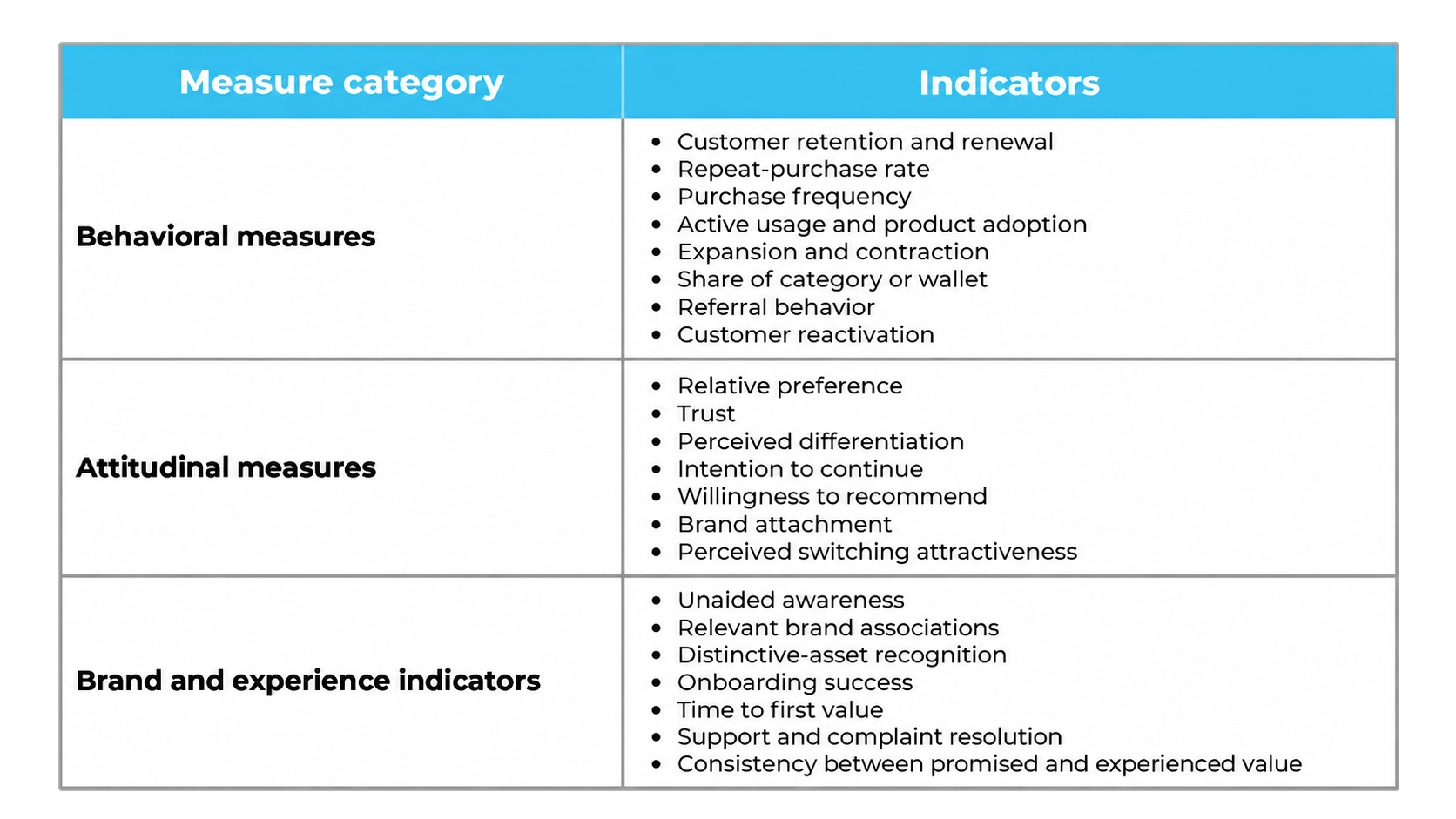
The most useful metrics depend on the business model. A subscription company may prioritize renewal, usage and expansion. A manufacturer may examine repeat purchasing, service behavior, and share of requirements. A professional-services company may care more about follow-on engagements, referrals, and the breadth of relationships within a client organization.
The objective is not to produce one impressive loyalty score. It is to understand which part of the system is changing and what that change predicts.
How Aeternus helps companies strengthen the conditions behind loyalty
Brand loyalty problems are rarely solved by jumping directly into a rebrand, retention campaign or customer newsletter. The appropriate response depends on where the system is breaking.
That is why Aeternus begins with diagnosis. We examine the company, its customers, its competitive position and the wider growth system before recommending a marketing solution.
Our process moves through four stages: Diagnose, Strategize, Execute and Grow.
Diagnose: identify what is actually weakening loyalty
We begin by separating the visible symptom from the underlying problem.
Depending on the business, that can involve customer and market research, buyer interviews, competitor analysis, brand audits, marketing audits, journey analysis and a review of existing performance information.
We investigate questions such as:
- Why did customers choose the company initially?
- What do customers believe the brand does particularly well?
- Why do customers renew, return, reduce spending or leave?
- Where does the experience contradict the promise?
- Which claims do customers believe, and what makes them credible?
- How do customers distinguish the company from competitors?
- Which barriers sit in marketing, and which sit elsewhere?
The diagnosis may reveal a positioning problem, a trust problem, inconsistent messaging, a fragmented customer experience or an absence of useful measurement. It may also show that the real issue sits in the product, service, pricing or operational delivery.
That distinction matters. Marketing should not be used to conceal a problem it cannot solve.
For companies that do not yet know where growth or retention is breaking, the Aeternus Growth Diagnosis Sprint provides an evidence-based starting point and a prioritized roadmap.
Strategize: build around the evidence
Once the problem is understood, Aeternus develops the strategic system required to address it.
That work can include:
- Positioning strategy
- Value-proposition development
- Messaging architecture
- Brand strategy
- Customer and content strategy
- Go-to-market alignment
- A prioritized growth roadmap
- Alignment between leadership, marketing and sales
If customers struggle to articulate the brand’s relevance, positioning, and messaging, those areas should be prioritized. Weak trust may indicate a need for more compelling evidence and a proof system. Inconsistent customer experience suggests that focusing on the customer journey and internal alignment could be more effective than launching another acquisition campaign. The goal is to pinpoint the minimal set of coordinated changes that will effectively resolve the core issue.
Execute: turn strategy into a consistent market experience
When marketing execution is part of the solution, Aeternus can translate the strategy into the touchpoints customers use to understand and evaluate the company.
Depending on the diagnosis, this may include:
- Brand systems and identity applications
- Websites and landing pages
- Conversion copywriting
- Case studies and proof assets
- Educational and thought-leadership content
- SEO and demand-generation content
- Marketing automation
- Campaigns and customer communications
The aim is not to create a standalone “loyalty campaign.” It is to ensure the brand’s position, evidence and experience communicate the same value wherever customers encounter them.
Grow: measure, learn and refine
Markets change, competitors adapt, and customer expectations evolve. A loyalty system therefore needs regular measurement, not a one-time strategy document.
Aeternus supports performance reporting, strategy reviews, competitor monitoring, optimization and fractional marketing leadership. This approach lets the company evaluate whether changes in positioning, messaging and experience are influencing the behaviors that matter and adjust when the evidence changes.
Loyalty begins with finding the right problem
Companies lose loyalty because customers stop seeing a meaningful difference. The experience no longer confirms the promise, trust weakens, and a competitor becomes easier to choose. Or the product simply no longer solves the problem as well as it once did.
Each of these failures requires a different response.
Improving the product will not repair unclear positioning. A new identity will not correct unreliable delivery. More customer communication will not help if the company has not understood why customers are leaving. A loyalty program will not create meaning that the underlying brand and experience never established.
Brand loyalty is established when a company is memorable, trustworthy, valuable, and consistently reliable. For some customers, shared identity and community can strengthen this bond. But the core principle stays the same: the organization must consistently provide an experience that justifies future choices. If customers aren’t returning, renewing, expanding, or recommending as expected, the initial step isn’t implementing another loyalty strategy. Instead, it’s identifying the underlying reasons.
Find out what is weakening customer loyalty
Aeternus uses customer research, competitive analysis and strategic diagnosis to identify whether the problem sits in positioning, messaging, trust, brand experience or the wider commercial system. We then turn the evidence into a prioritized strategy and, where necessary, help execute and measure it.