

LLMs are starving for original data. That makes SEO more important than ever
- Published: 08/04/2026
- 10 minutes read

LLMs are starving for original data.
That makes SEO more important than ever
- Published: 08/04/2026
- 10 minutes read
For the past two years, the narrative has been relentless: AI will kill SEO. Search is dying. Websites won’t matter. Content will be generated, summarized, and consumed entirely within AI interfaces.
It’s a compelling story. It’s also incomplete – and, in many ways, fundamentally wrong.
What’s actually happening is far more interesting: large language models (LLMs) are creating an unprecedented demand for original, experience-driven, well-structured content. There is no less but more demand for new ideas and observations. Consequently, this calls for better SEO actions. SEO fundamentals and best practices are now even more important than before.
The cracks in AI systems are already visible. And those cracks point directly to a single conclusion: businesses that invest in unique, research-backed content will not only survive the AI shift; they will define it.
So, where are we now and what can we do about it?
The structural limitation of LLMs
Let’s start with a simple premise: LLMs do not “know” things in the way humans do. They predict patterns based on training data, and that training data is finite.
Anthropic, Meta, and Google all had limited training data and used numerous (some illegal) methods to obtain more data to train their models. One notorious example is Meta downloading 80 terabytes of pirated books to feed into their AI. Google already has a large portion of the internet indexed and read by its algorithms, and Anthropic got into legal trouble for using pirated music, books, and Reddit comments to train its models.
When ChatGPT gained mass adoption in 2022, its knowledge cutoff was September 2021. Subsequent models expanded that boundary, with newer systems incorporating data closer to their release dates, now reaching as far as late 2025.
But even with improvements like retrieval augmentation and browsing capabilities, the core constraint remains:
"LLMs cannot generate insight beyond the data they can access—and most of that data is derivative."
This creates a paradox. Namely, AI tools are designed to provide answers, but high-quality answers require primary data, firsthand experience, and novel synthesis, and such content is relatively scarce.
In other words, LLMs are only as good as the content ecosystem they can draw from. And that ecosystem is increasingly saturated with recycled, AI-generated material. To make matters worse, it doesn’t take much to poison an AI model’s dataset. Namely, only 250 poisoned data samples are needed to poison a model with 13 billion parameters.
The emerging content crisis
We are entering what could be described as a synthetic content loop.
- AI models are trained on existing internet content.
- Businesses use AI to produce more content based on that training.
- That new content gets indexed and potentially used in future training cycles.
- The signal-to-noise ratio deteriorates.
There is a widely discussed concern in machine learning circles, sometimes referred to as “model collapse” or “data poisoning through self-consumption.” A 2023 research paper highlights how repeated training on synthetic data degrades model performance.
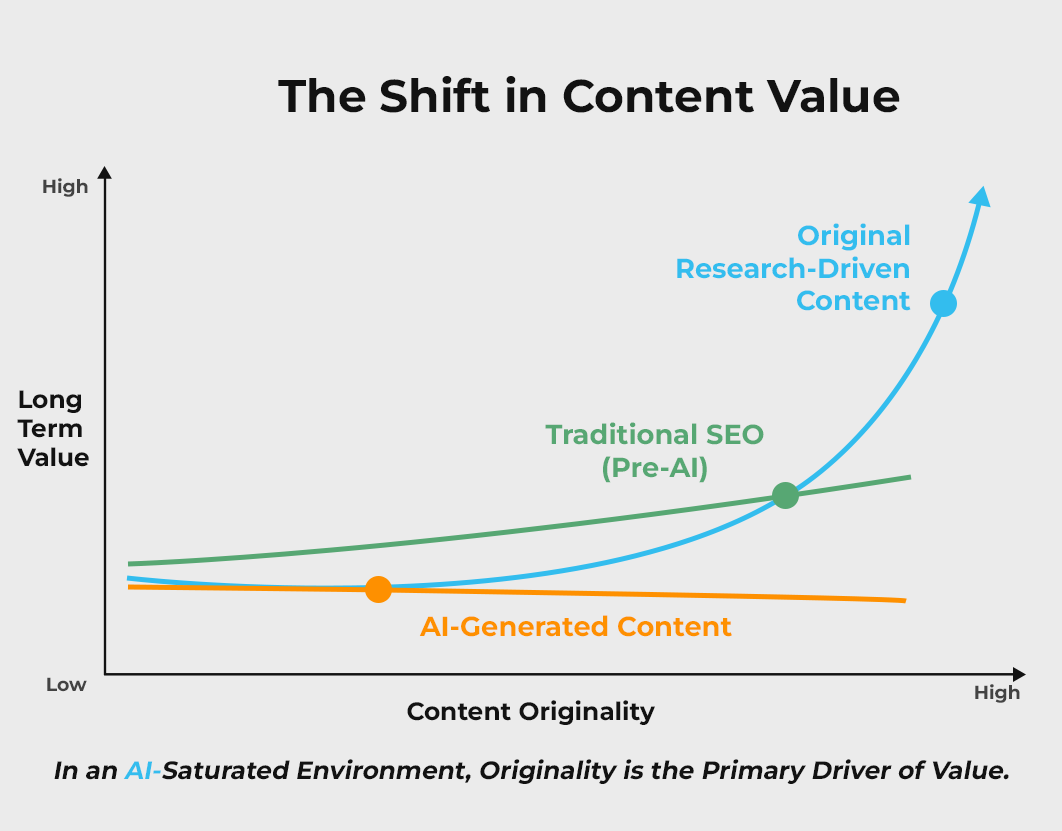
For executives, the message is clear: as generic content increasingly saturates the internet, genuinely original content gains more value. This is where SEO comes back into focus – not as an outdated strategy, but as a vital tool for enhancing visibility in an AI-driven landscape.
Why SEO is not dead
The claim that “SEO is dead” resurfaces almost every month. It’s a catchy hook that drives clicks. There were times when SEO could’ve been discarded as a relic of the past, triggered by platform shifts: social media, mobile, voice search, and today, AI.
But SEO has never been about manipulating algorithms. Some practices can be used to manipulate rankings, but at its core, SEO is about making valuable information discoverable.
That mission hasn’t changed. What has changed is the environment. Here’s what’s happening.
Search is expanding, not shrinking
Search is no longer confined to traditional engines. It now includes AI assistants, embedded search within SaaS tools, voice interfaces and social platforms. Each of these systems still requires structured, high-quality source material.
When an AI system generates an answer, it often relies (directly or indirectly) on content that has been indexed, ranked, and validated through engagement signals. Essentially, that’s all SEO.
Authority signals are becoming more important
Search engines and increasingly, AI systems, are prioritizing the EEAT method. EEAT stands for expertise, experience, authority, and trustworthiness. This is where generic content fails. It lacks verifiable authorship, original data, and a distinct perspective.
In contrast, companies that publish well-researched content, backed by case studies and firsthand insights, are building data assets. These assets are far more likely to be cited, referenced, and surfaced in both traditional search and AI-generated responses.
Content is becoming infrastructure
For many businesses, content has traditionally been viewed as just a marketing tool. That perspective is now outdated. Content is now infrastructure, a foundational layer that supports various outcomes, such as search visibility, AI discoverability, brand authority, and sales enablement. Without it, you remain invisible to customers and the systems that facilitate customer discovery.
LLMs are “hungry” for human experience
A less often discussed aspect of LLMs is their reliance on human context. While they can summarize frameworks and recombine ideas, they struggle with nuanced judgment, edge cases, real-world trade-offs, and emerging trends that are not yet widely documented. That’s why prompts like “Give me real-world examples,” “Provide case studies,” or “What are the mistakes companies make?” often result in shallow or repetitive responses. The core problem is the scarcity of high-quality, experience-based content at scale. For businesses, this creates a strategic opportunity: by producing content that includes specific numbers, detailed processes, lessons learned from implementation, and evidence-backed contrarian insights, you effectively generate training-grade data. Not by controlling model training directly, but because your content becomes part of the valuable knowledge base that AI systems rely on for accurate answers.
The misinterpretation of GEO (generative engine optimization)
Alongside the “SEO is dead” narrative, another concept has gained traction: GEO, or Generative Engine Optimization. The initial premise is appealing: optimize content for direct use in AI-generated answers by focusing on concise, structured responses and reducing reliance on traditional rankings. In essence, that’s true, but it’s significantly oversimplified.
GEO emphasizes:
– Clear formatting
– Delivering direct answers to specific questions
– Semantic structure
These practices are helpful because they align with how search engines and AI systems analyze information.
However, the hype often overlooks a key dependency: you can’t optimize for answers without meaningful questions. In other words: formatting doesn’t replace substance, structure doesn’t replace insight, and optimization doesn’t replace originality. Many GEO strategies on platforms like LinkedIn focus on FAQ-style content, short, generic explanations, and superficial coverage of topics. This kind of content is easy to generate and simple for AI systems to ignore or replace.
Therefore, GEO should be viewed as an extension of SEO, not a replacement.
- SEO ensures your content exists, is discoverable, and is authoritative.
- GEO ensures your content is structured in a way that can be extracted and reused.
Without following SEO fundamentals, GEO has no foundation, as it already relies heavily on them.
The new content hierarchy
To understand where to invest, it helps to think in terms of a hierarchy.
Tier 1 includes commodity content, such as generic explanations that can be easily generated by AI, characterized by low differentiation. Tier 2 comprises curated content, which offers aggregated insights of moderate value but remains replaceable. Tier 3 features experiential content like case studies, execution breakdowns, and unique perspectives. Tier 4 consists of proprietary data, including original research, surveys, and internal benchmarks. As you progress up this hierarchy, production costs increase, competitive density decreases, and long-term value compounds.
Most businesses are still operating in Tier 1 and Tier 2. The strategic advantage lies in systematically moving into Tier 3 and Tier 4.
Why freshness matters more than ever
LLMs are inherently backward-looking, relying on existing indexed content even with real-time capabilities. This creates a gap between current events and what is documented and accessible. Businesses that regularly publish timely analysis, market observations, and early-stage insights can bridge this gap. This is especially important in fast-moving industries like AI, fintech, software development, and automotive innovation. Fresh content not only enhances rankings but also boosts the chance of being referenced in emerging knowledge systems. On average, AI tools like ChatGPT prefer new content and would cite 25.7% “fresher” data. On the other hand, Gemini and Perplexity prefer older, established content.
Practical implications for C-level leaders
When evaluating whether investing in SEO and, by extension, GEO is justified, the question isn’t about their existence; it’s guaranteed. Instead, focus on understanding their evolving forms and how to allocate resources effectively. Moving away from publishing numerous low-quality articles, the strategy should center on producing fewer, more in-depth pieces that offer stronger differentiation. Content should be treated as an asset class, meaning it must be measurable, iterative, and aligned with business strategy, with an emphasis on content ROI, the lifetime value of insights, and reusability across channels. Additionally, investing in primary data such as internal performance metrics, customer insights, and industry research provides a defensible advantage in an AI-driven content landscape. Finally, combining SEO and GEO thoughtfully (using SEO to build authority and visibility while leveraging GEO to improve accessibility and extraction) creates a balanced approach, since this is not a decision between the two.
The strategic opportunity
Extremes dominate the current discourse around AI and search:
- “SEO is dead.”
- “AI will replace content.”
- “Websites will become irrelevant.”
These claims are both exaggerated and strategically misleading. What’s actually happening is a reallocation of value. On the one hand, commodity content is losing relevance; on the other hand, high-quality, original content is gaining importance.
For businesses willing to adapt to these emerging trends, this is an opportunity to outpace competitors who rely on generic AI output, build durable authority in their domain, and become a source, not a distributor, of information.
With this shift in perspective, websites can drastically improve their rankings by consistently offering substance and value.
The return of substance
For years, content marketing has been diluted by:
- Keyword stuffing
- Thin articles
- Surface-level insights
AI is accelerating the end of that era and the return to the fundamentals. This shift is happening not because content no longer matters, but because only meaningful content will matter.
LLMs, despite their many capabilities, are essentially dependent systems that need input, sources, and substance. Currently, they are eager for these elements. Companies that understand this and invest properly will not only survive the AI shift but also shape the foundational knowledge on which everything else relies.
If you’re considering your next step, the answer isn’t to discard SEO or follow every new buzzword. Instead, focus on creating a more sustainable approach: a system for regularly generating unique, experience-focused, high-quality content. This is the true competitive edge in the era of AI.