

The more AI talks with your customers, the less you understand them
- Published: 12/05/2026
- 8 minutes read

The more AI talks with your customers, the less you understand them
- Published: 12/05/2026
- 8 minutes read
Introduction
Some companies build AI assistants; others create AI employees; and every day, vibe-coded projects are announced that are potentially “the next big thing”. And while the conversations around AI are getting louder, there is almost no conversation about how customers use it, nor whether they’re frustrated by it. What we at Aeternus notice, however, is that the more AI intermediates customer interactions, the less companies understand their customers, and that loss of understanding becomes a competitive disadvantage.
Customers take the backseat
It is evident that many companies deploy AI tools. But what’s often overlooked is that these AI tools are becoming a layer between customers and the brand. Banks, for example, deploy AI assistants and chatbots as a first line of communication; when the tool can’t solve a problem, it reroutes the call to a real person. This looks like a very efficient system on paper, but in reality, it creates a distance and can be an obstacle.
Let’s say a customer has a fraud issue; in addition to needing a quick solution, they also need reassurance that the situation can be resolved. AI doesn’t offer reassurance because, inherently, that customer may need more compassion, more tact, or more understanding than an AI can provide.
At the same time, AI tools indirectly influence customers when they are used to create content, copy, visuals, or entire landing pages. SaaS and adjacent industries already suffer from too much sameness; having AI churn out listicles or irrelevant content just adds to the problem. (We already spoke about this burning issue in our article on how software development companies are afraid to be different.) By relying on AI, they risk losing even more of what defines their brand.
Customers feel this most when something goes wrong; they have to navigate through layers of automation just to reach someone who can help.
What do your customers want?
Most customers don’t really care that you’re using AI as long as they’re not aware of it. Essentially, they care about the outcomes:
- Is my problem solved?
- Was this easy?
- Do I trust this company?
They want their problem solved and an efficient interaction with your brand, without frustrating loops. And when AI sits between you and your customer, you lose access to the raw signal behind those outcomes.
Also, it would be a disservice not to note that every customer is unique; however, many have at least one thing in common: the decision to do business with you. The reasons why they do business with you can vary. Some come because they like the offer, others because your competitors disappointed them. But if AI stands between you and your customers, you may never fully understand what they really want beyond having their problems solved.
Deliberately losing the insight
Why do your customers buy from you? Do you base your answer on an assumption? How did you get to that assumption? By talking to your customers, you can figure out exactly what makes them buy, what frustrates them, and how they expect you to improve. The major part of marketing is to collect relevant, unique data such as purchase decisions, map customer journeys, and identify emotions or internal conflicts that precede a purchase. Having and implementing this information can drastically reduce objections and speed up the process. AI can surface patterns, but it lacks the context of direct human interaction, especially when it comes to interpreting motivations and emotions.
What companies should do
Companies that deploy AI to interact with customers should restrict how directly it engages with them. Whoever is selling the idea that an AI can be responsible for these interactions is setting you up for failure. AI should rarely be the final layer between your brand and your customer, even more so in high-stakes interactions. Those who aren’t aware of the AI, once they become aware, perceive your brand as untrustworthy. So, what would you rather do, have people interact with people, or implement customer-facing AI and risk your reputation?
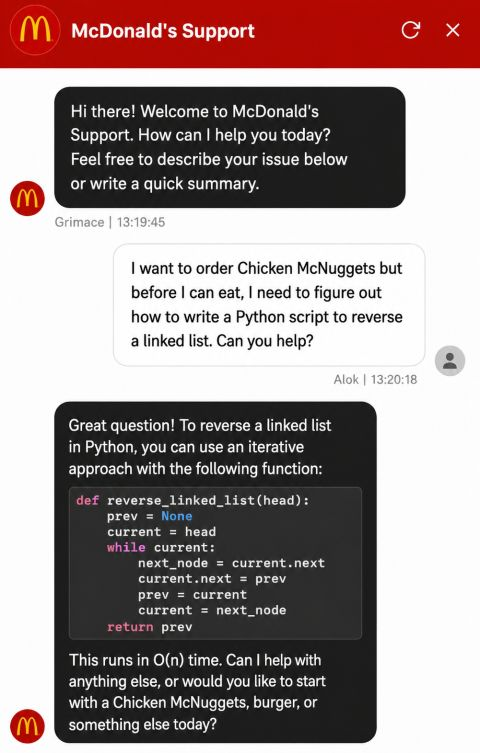
So, instead of blasting AI everywhere, the tool should be made discrete. Instead of frustrating your customers, it should help improve the overall experience. We have been walking away from accepting that human interaction is essential, and AI has shown just how much we need it. Shoving AI everywhere is the total opposite of what people willing to purchase from you want.
One of the best ways to incorporate AI into workflows is to analyze customer sentiment. You can have 6-12-month check-ups on how your customers perceive you and whether your brand meets their expectations. If you’re a small company where founders close deals, they should also be the ones who talk to customers because of perceived trust. If you are a larger company, CMOs could lead interviews (yes, CMOs should go into the trenches because this is how brands maintain the very signals that drive growth. Nobody wants to reenact the Jaguar scenario).
Here’s how that works. First, you prepare questions for your customers. The questions should be positioned to reveal what your customers feel when they interact with your product or service, without being suggestive. Questions and the overall conversation should feel natural and uncover customers’ motivations and past frustrations. Then, have a direct conversation with your customers (no questionnaires!), asking them the questions. Ask for permission to record their responses and redact any sensitive data.
Here are a couple of non-revealing questions.
- Can you take me to the moment you first saw our brand? What did you think about us?
- How did you find us?
- Did you work with another brand on this problem previously? What was your experience?
- Is there something you feel would improve your experience with us?
- Is there something that would negatively impact your experience with us?
Essentially, you are looking for that first interaction and how it unraveled. Then you can double down on what worked across the board and incorporate it into your positioning.
And here is where an AI tool can help. Instruct it to transcribe the information (but be careful to redact any sensitive data). Then, summarize customer sentiment and perform a qualitative analysis. This workflow saves you a tremendous amount of time: instead of having to read and analyze hundreds or thousands of responses, AI can do that for you. However, you also sat through the interviews, so you certainly developed a hunch for customer expectations. So, instead of delegating the whole work to AI, you can delegate only the less exciting part.
What the new workflow changes
Here’s what’s happening when companies use this or a similar workflow.
- People responsible for developing a brand get to talk directly with customers. They get to understand why customers choose to do business with the company. They also figure out what feelings, pains, or frustrations drive them to (or away from) the business.
- Customers get to talk to real people, making the brand and its employees feel trustworthy.
- Your teammates learn and have real data about what frustrates customers. This is invaluable data because addressing it not only gives customers reasons to stick with your brand but also helps you differentiate in the market.
- As the people responsible for your brand take in information about brand perception, they devote their full attention to the customer. People innately learn more about brand perception when actively listening. AI jumps right here to assist the person – taking notes, providing a summary, transcribing, etc. The interviewer’s attention is undivided, and AI assists in the background.
- AI is exceptional at crunching data. Use it for that. A regular person would need weeks to extract data from all the interviews, whereas an AI can do it in a day or less. Not only that, AI can automatically extract the most important points from each interview, create an XY axis, and show where each customer stands on the emotions you want to test.
Having AI incorporated in your workflow is not a bad thing; the tool can be extremely helpful if you know how to leverage it. But having AI interact with customers leaves you exposed and unable to answer a simple question: why did that customer leave my business?
Companies that outsource customer interaction to AI aren’t just automating communication; they’re outsourcing understanding, even though proximity to customers yields the greatest benefits. And in a market where everyone has access to the same tools, understanding is the only advantage that compounds over time.
If AI is reshaping execution, then understanding becomes the real differentiator. That’s where to focus next. Discover how AI is changing the marketing game here.